Bihar's ₹1.72 Lakh Crore Energy Gamble! Two Nuclear Plants and Four Storage Projects Planned
Bihar Announces a Major Energy Expansion Plan
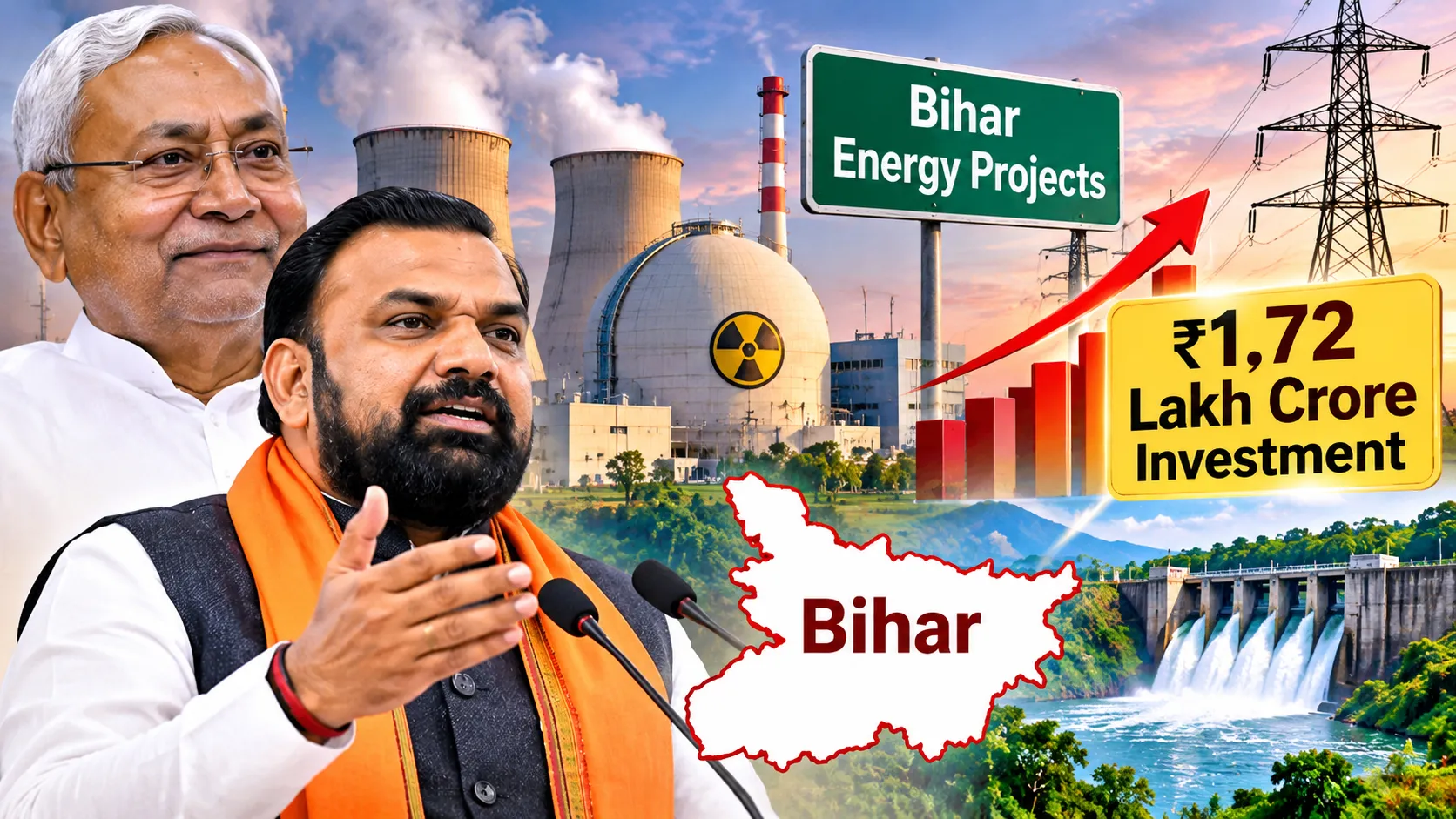
Bihar is preparing for a significant expansion of its energy infrastructure, with the state government signing memorandums of understanding worth approximately ₹1,72,885 crore for six proposed energy projects.
The agreements were exchanged on November 20 during an investment ceremony organised under Bihar Business Connect 2026 in Patna.
Chief Minister Samrat Choudhary attended the event alongside Deputy Chief Ministers Vijay Kumar Choudhary and Bijendra Prasad Yadav and Industries Minister Shreyasi Singh.
The proposed investment includes two nuclear power plants and four pumped storage projects.
The announcement represents an important part of the state's wider strategy to attract industrial investment and strengthen electricity infrastructure.
Two Nuclear Power Plants Planned for Bihar
The most significant component of the proposal involves two nuclear power plants.
The first project is planned at Bhitiya in Banka district and is associated with NTPC.
It involves a proposed investment of ₹70,000 crore and a planned capacity of 2,800 MW.
The second nuclear power plant is proposed at Talhar in Raghunathpur, Siwan district, through the Nuclear Power Corporation of India Limited (NPCIL)
This project also involves an estimated investment of ₹70,000 crore and a proposed capacity of 2,800 MW.
Together, the two projects represent:
Proposed investment: ₹1.40 lakh crore.
Combined planned capacity: 5,600 MW.
Locations: Banka and Siwan.
These projects remain at the agreement and proposal stage. Their implementation will depend on the necessary approvals, land arrangements, technical assessments and other regulatory requirements.
Four Pumped Storage Projects Across Three Districts
Apart from nuclear energy, the government has also signed agreements for four pumped storage projects.
These projects are proposed across Nawada, Jamui and Aurangabad.
The proposed investments are:
Adani Hydro Energy: ₹9,900 crore for an 1,800 MW project in Nawada.
Adani Hydro Energy: ₹9,900 crore for an 1,800 MW project in Jamui.
Torrent Energy Storage Solutions: ₹7,685 crore for a 1,500 MW project in Nawada.
Greenko Energies: ₹5,400 crore for a 900 MW project in Aurangabad.
The four projects together involve a proposed investment of ₹32,885 crore.
Their combined planned generation capacity is 6,000 MW, with an energy storage capacity of 36,078 MWh.
Pumped storage technology uses electricity to move water into an elevated reservoir and releases it through turbines when electricity is required.
Samrat Choudhary Government's 2030 Energy Target
The energy expansion plan is closely connected with the Bihar government's industrial development ambitions.
Chief Minister Samrat Choudhary has stated that the government aims to ensure 24-hour availability of affordable, quality and uninterrupted electricity for industries by 2030.
Reliable electricity is an important requirement for manufacturing, information technology, logistics and other industrial sectors.
Without dependable power infrastructure, attracting large-scale investment becomes more difficult.
The proposed energy projects are therefore being positioned as an important foundation for Bihar's industrial ambitions.
Political Significance for the NDA Government
The announcement provides the Samrat Choudhary-led NDA government with an opportunity to strengthen its development narrative.
Industrial investment, infrastructure expansion and employment generation are important political issues in Bihar.
The government can present these proposals as evidence of its efforts to attract large investors and improve the state's economic prospects.
However, the real political test will be implementation.
Announcements and MoUs are important initial steps, but people will ultimately judge the government through completed projects, reliable electricity and employment opportunities.
What Happens Next?
The next major step will involve project preparation, approvals, land-related procedures and detailed implementation planning.
The progress of the Banka and Siwan nuclear proposals will be particularly important because they represent the largest share of the proposed investment.
The pumped storage projects will also require further technical and administrative progress.
The coming years will determine whether Bihar can translate these agreements into operational infrastructure.
Conclusion
Bihar's ₹1.72 lakh crore energy investment announcement represents one of the state's most ambitious proposed infrastructure initiatives.
With two nuclear power plants and four pumped storage projects, the Samrat Choudhary government is attempting to connect energy expansion with industrial growth.
But the biggest question remains: can the government turn these massive investment agreements into completed projects by its stated development timelines?
For Bihar, the real political victory will not come from signing MoUs alone. It will come when the promised power infrastructure becomes a reality.