Bihar's Mega Infrastructure Push! Six-Lane Buxar–Bhagalpur Expressway to Cross 13 Districts
Samrat Choudhary Government Takes a Major Infrastructure Decision
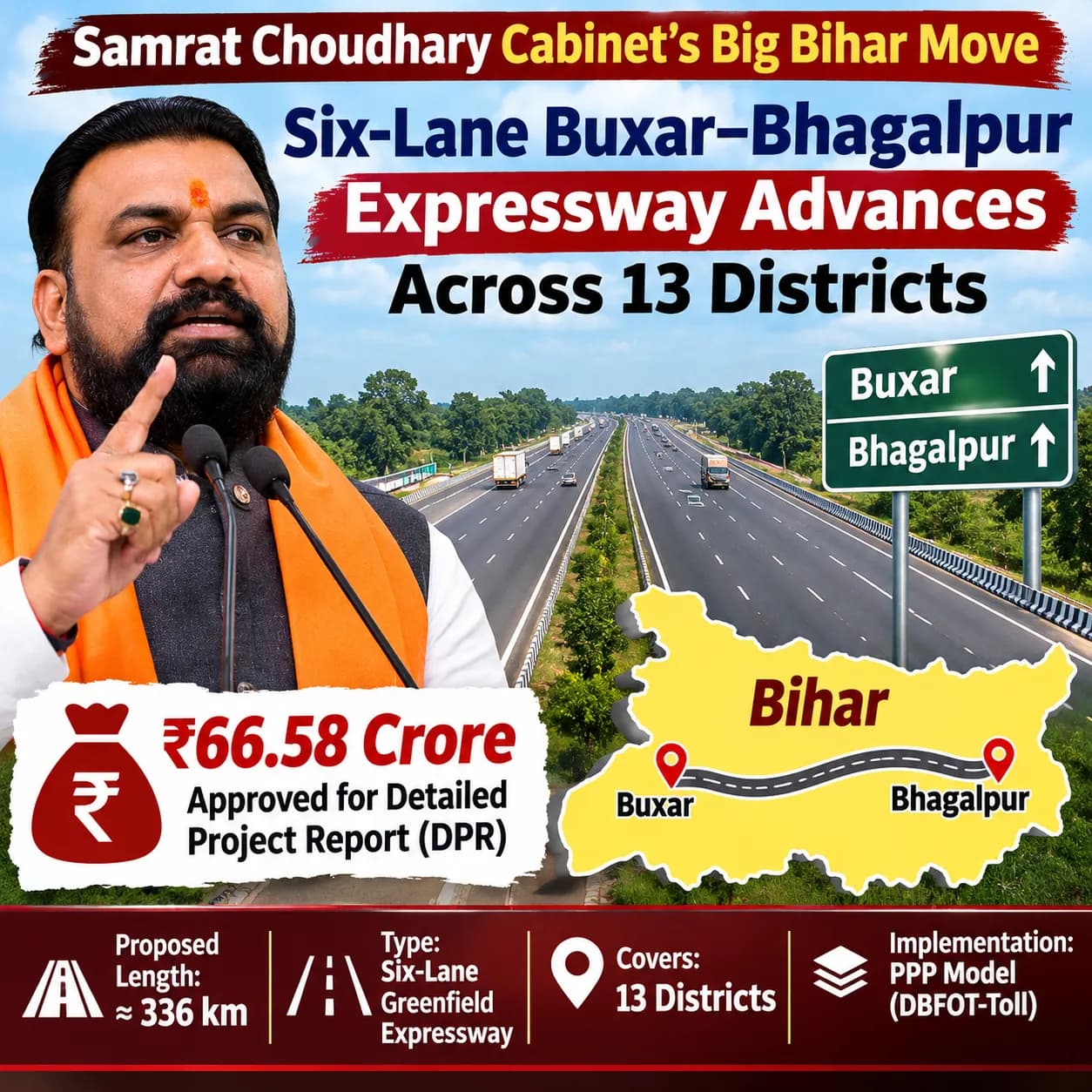
Bihar's road infrastructure plans have received a significant push after the cabinet led by Chief Minister Samrat Choudhary approved ₹66.58 crore for preparing the Detailed Project Report (DPR) of the proposed Buxar–Bhagalpur six-lane expressway.
The decision was taken during the state cabinet meeting on November 18, 2026.
The proposed project is expected to cover approximately 336 kilometres and connect western Bihar with the eastern part of the state through a modern, access-controlled highway corridor.
The project is particularly important because its proposed route will pass through 13 districts, potentially improving transportation links for several regions that are expected to benefit from improved road connectivity.
Six-Lane Expressway to Connect 13 Bihar Districts
According to the reported project details, the proposed expressway will pass through the following 13 districts:
The proposed corridor is expected to strengthen connectivity between several important urban, commercial and regional centres.
For residents of these districts, improved road infrastructure could eventually reduce travel difficulties and create better opportunities for transportation and business activities.
Why Is the ₹66.58 Crore DPR Approval Important?
The approval of ₹66.58 crore is an important step towards developing the proposed project.
A Detailed Project Report is necessary before a major infrastructure project moves towards implementation.
It generally examines several aspects, including:
Technical feasibility of the proposed highway.
Estimated construction and development costs.
Land requirements and possible acquisition.
Environmental and social considerations.
Traffic projections and transportation demand.
Financial viability and investment arrangements.
Construction planning and implementation requirements.
The cabinet has also approved engaging a transaction adviser for the project.
The adviser will support the process of developing the project's implementation and financial framework.
Project Planned Under Public-Private Partnership Model
Another important feature of the proposed Buxar–Bhagalpur Expressway is its planned implementation through the Public-Private Partnership (PPP) model.
Road Construction Minister Kumar Shailendra has stated that the project is proposed under the Design, Build, Finance, Operate and Transfer (DBFOT-Toll) model.
Under this arrangement, a private concessionaire may be responsible for designing, constructing, financing and operating the highway according to the agreed terms.
The model is intended to involve private investment and expertise in developing large-scale road infrastructure.
Strategic Connectivity Between Western and Eastern India
The proposed expressway is not just a road connecting Buxar and Bhagalpur.
It is also expected to contribute to a wider transportation corridor linking different parts of eastern and northern India.
According to the reported project plan, the Buxar–Bhagalpur corridor will connect with the Purvanchal Expressway in the west and the proposed Raxaul–Haldia Expressway in the east.
This could strengthen the broader Delhi–Lucknow–Buxar–Bhagalpur–Haldia transportation corridor.
Such connectivity could be important for the movement of goods, agricultural products, industrial materials and commercial vehicles.
How Could the Expressway Benefit the 13 Districts?
The proposed highway could create opportunities across multiple sectors.
1. Better transportation connectivity
A six-lane access-controlled expressway could improve long-distance road travel and provide a more efficient transportation route.
2. Industrial development
Improved road connectivity can make industrial locations more accessible and potentially attract investment in manufacturing and logistics.
3. Employment opportunities
Large infrastructure projects can generate employment during construction and create additional opportunities in transportation, maintenance and related services.
4. Agricultural transportation
Farmers and agricultural traders could potentially benefit from better connectivity to markets, warehouses and distribution centres.
5. Growth in commercial activity
Better transportation links could encourage logistics facilities, warehouses, roadside services and other commercial activities along suitable locations.
Political Significance for the Samrat Choudhary Government
The cabinet's decision is also politically significant for the Samrat Choudhary-led government.
Infrastructure development is an important component of governance and public accountability.
By advancing the planning process for a major highway corridor, the government has placed regional connectivity and long-term infrastructure development in focus.
The project could become an important development issue for the 13 districts included in the proposed route.
Residents, business organisations and local representatives will likely expect the government to move beyond planning and provide clear information about land acquisition, construction timelines and implementation.
What Happens Next?
Following the cabinet's approval, the next major step will be the preparation of the Detailed Project Report.
Authorities will need to examine the technical and financial feasibility of the project and determine its implementation requirements.
Further approvals, financial arrangements, land-related procedures and other necessary clearances will be important before construction can begin.
At present, the cabinet's decision should be understood as approval for the project-planning stage, not confirmation that construction has started.
Conclusion
The approval of ₹66.58 crore for the Buxar–Bhagalpur Expressway DPR represents an important development in Bihar's infrastructure planning.
The proposed 336-km six-lane corridor has the potential to improve connectivity across 13 districts and strengthen transportation links between western and eastern Bihar.
Its proposed connection with the wider Purvanchal and Raxaul–Haldia highway network could also make it strategically important for regional trade and logistics.
However, the real test will be the completion of the DPR, subsequent approvals and timely implementation.
For Bihar, the project represents an ambitious infrastructure proposal whose eventual impact will depend on how effectively the government turns its planning into reality.