Darbhanga's Ashok Paper Mills Back in Focus: Samrat Government Moves to Reclaim Land for Industrial Use
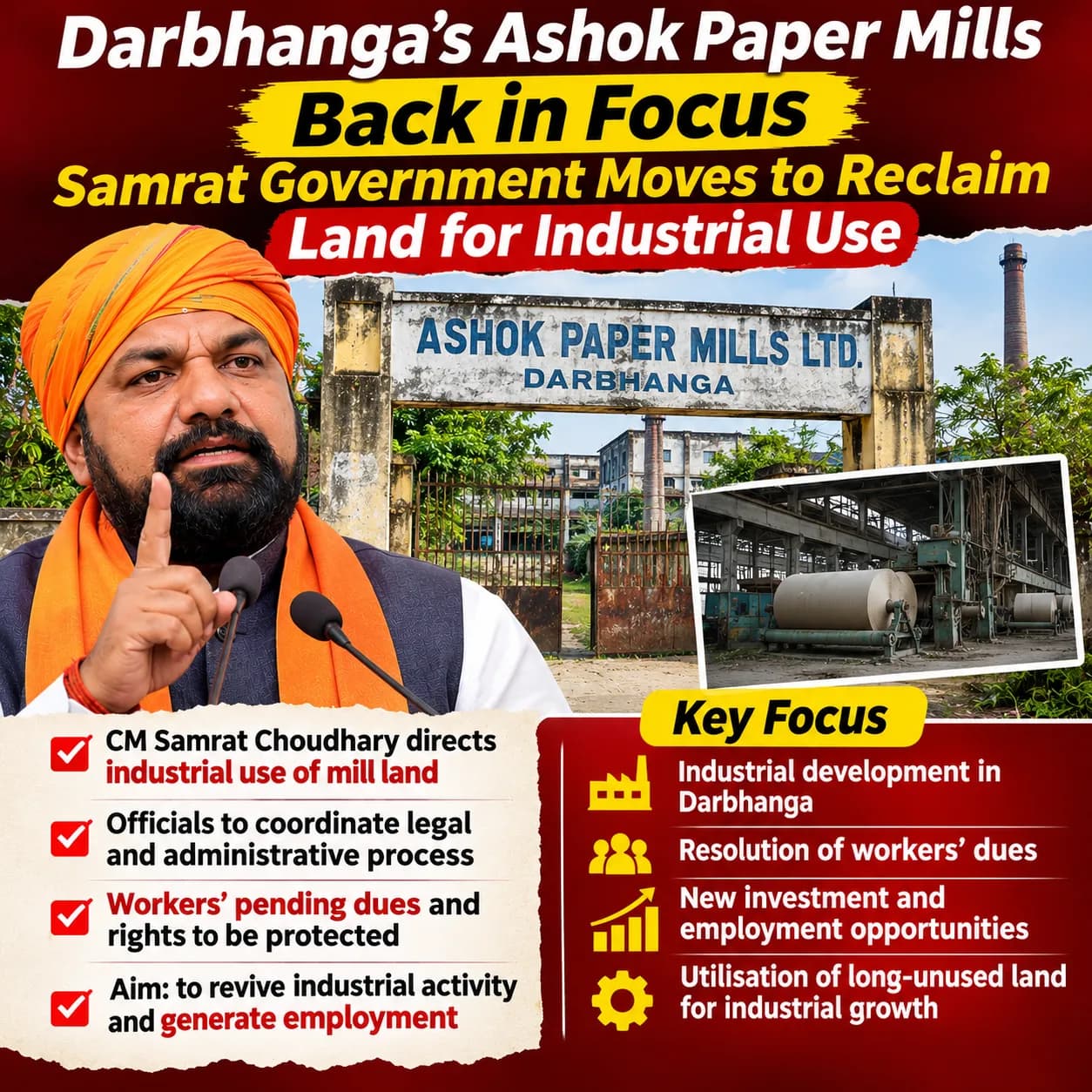
The long-pending issue surrounding Ashok Paper Mills in Darbhanga has returned to the centre of Bihar's industrial development agenda after Chief Minister Samrat Choudhary directed officials to initiate the process of bringing the mill's land under industrial use.
The decision was taken during a review meeting held on November 18 at the Sankalp auditorium in Patna.
The meeting focused on the status of Ashok Paper Mills Limited (Bihar Unit), its historical operations, the present condition of its land and the possibilities of future utilisation.
The development is significant for Darbhanga and the wider Mithila region, where the closure of major industrial establishments has long been associated with employment and economic development concerns.
Chief Minister Directs Officials to Begin the Process
During the meeting, Chief Minister Samrat Choudhary instructed the Industries Department and other concerned officials to coordinate and take the necessary steps towards the industrial utilisation of the land.
According to the official press release issued by the Chief Minister's Office, the Industries Department Secretary and Darbhanga District Magistrate presented details regarding the history and present status of the mill.
The Chief Minister directed the Industries Department Secretary, Darbhanga District Magistrate, Chief Secretary and Advocate General to coordinate on the matter.
The administration has been asked to examine the necessary issues and move forward with the process.
Importantly, the government has not announced that a particular industrial project has already been finalised for the site.
A Historic Industrial Establishment in North Bihar
Ashok Paper Mills was once an important industrial establishment in the Darbhanga region.
Established in 1958 by the Darbhanga Raj, the mill played a significant role in the industrial history of north Bihar.
The factory was spread across approximately 400 acres at Rameshwar Nagar in the Hayaghat area.
At its peak, the establishment provided employment to more than 1,000 workers.
For the surrounding communities, the mill represented more than a manufacturing facility. It supported employment, local economic activity and industrial development.
However, financial and operational difficulties gradually affected its functioning.
The state government took over the mill in 1970, but production stopped in 1982.
Attempts to revive the establishment subsequently failed, and the factory eventually shut down in November 2003.
Workers' Rights Remain a Major Concern
One of the most important aspects of the latest government decision is its emphasis on workers' interests.
Chief Minister Samrat Choudhary has stated that workers' pending liabilities and lawful entitlements must receive priority.
The government has indicated that it is seriously considering the issue of outstanding payments.
This is important because industrial land redevelopment should not ignore the interests of employees who worked at the establishment before its closure.
For former workers and their families, the announcement raises expectations that their long-pending concerns may receive renewed attention.
However, the government has not yet announced a final settlement amount or a confirmed payment schedule.
What Could Industrial Reuse Mean for Darbhanga?
Bringing the land under industrial use could create new opportunities for Darbhanga if the process eventually results in productive investment.
Potential benefits could include:
New industrial investment in the region.
Employment opportunities for local residents.
Improved economic activity around Hayaghat.
Greater industrial development in north Bihar.
Opportunities for supporting businesses and local suppliers.
However, these benefits will depend on the nature of the future project, investment decisions, legal clearances and implementation.
Political Implications for the Samrat Choudhary Government
The Ashok Paper Mills issue carries political importance because industrial development and employment remain major concerns in Bihar.
The government can present the initiative as an effort to make productive use of long-unused industrial assets.
For the BJP-led administration, the challenge will be to convert the announcement into an actionable development plan.
Opposition parties could also question why the mill remained closed for so many years and whether the new initiative will deliver actual employment.
The protection of workers' rights will be equally important in determining the credibility of the government's approach.
What Happens Next?
The immediate priority will be coordination between the Industries Department, Darbhanga district administration and the state's legal authorities.
The next stages will involve examining the land's legal and administrative status and determining the appropriate route for its future industrial utilisation.
A final industrial project, investment commitment or construction schedule has not yet been officially announced.
Conclusion
The Samrat Choudhary government's latest decision has revived attention towards one of Darbhanga's most significant closed industrial establishments.
Ashok Paper Mills could become an important opportunity for industrial redevelopment in north Bihar if the government successfully addresses the legal, administrative and workers' concerns.
The real measure of success will be whether the proposed industrial utilisation eventually generates investment, employment and economic benefits for the people of Darbhanga.