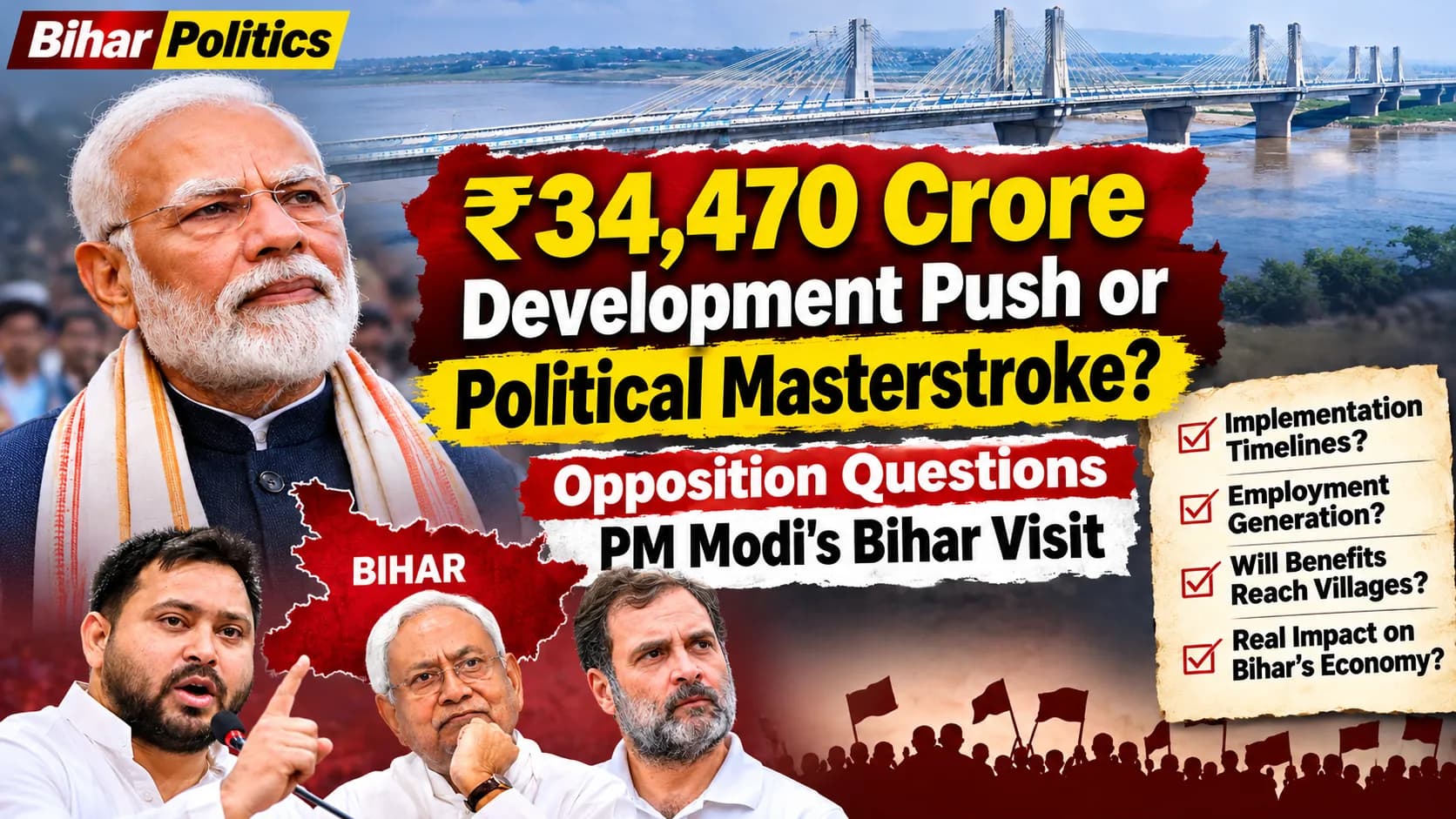
₹34,470 Crore Development Push or Political Masterstroke? Opposition Questions Modi's Bihar Agenda
Introduction: A Big Announcement, Bigger Political Questions
Bihar is once again at the centre of national political attention.
On November 21, 2026, Prime Minister Narendra Modi is scheduled to visit Vaishali district to inaugurate, dedicate and lay the foundation stones of development projects worth approximately ₹34,470 crore. The programme includes a major Ganga bridge, road infrastructure, electricity projects, urban facilities, education, healthcare and public transport initiatives.
For the ruling establishment, the visit represents a major development opportunity. For the opposition, however, such a large announcement also creates an opportunity to question the government's record, priorities and accountability.
The central political question is not simply how much money has been announced. It is how effectively that money will be used, how quickly projects will benefit ordinary citizens and whether the government can demonstrate measurable improvements in employment, education, healthcare and economic opportunities.
A development announcement can create expectations. Delivering the promised results is the real test of governance.
₹34,470 Crore: What Does the Opposition Want to Know?
The scale of the announced investment is significant. According to the Prime Minister's Office, the projects cover several important sectors.
The programme includes projects worth more than ₹15,600 crore scheduled for inauguration and dedication, while projects worth approximately ₹14,450 crore are planned for foundation-stone laying. The overall package also includes the Nitish Setu project and other initiatives.
However, the opposition's scrutiny should focus on several questions.
First, how much of the announced investment will immediately translate into operational public infrastructure?
Second, what are the completion deadlines for projects whose foundation stones are being laid?
Third, what mechanisms will ensure transparent expenditure and prevent delays?
Fourth, how will the government measure whether these projects improve household incomes, employment opportunities and access to essential services?
Nitish Setu: A Bridge Between Two Banks, But What About the Wider Development Gap?
One of the biggest attractions of the Prime Minister's visit is Nitish Setu, a six-lane extradosed cable-stayed bridge across the Ganga.
The 19.7-kilometre project connects Kachhi Dargah in Patna district with Bidupur in Vaishali district. It consists of a 9.7-kilometre main bridge and approximately 10 kilometres of approach roads.
The official project cost announced by the PMO is approximately ₹4,280 crore.
The bridge is expected to improve connectivity between northern and southern Bihar and reduce pressure on existing Ganga crossings, including Mahatma Gandhi Setu and JP Setu.
But infrastructure development cannot be measured only by the construction of a large bridge.
The opposition perspective should also examine whether smaller towns, rural roads and poorly connected villages receive sufficient attention.
Will farmers gain easier access to agricultural markets? Will transport costs decrease? Will local businesses receive new opportunities? Will people in remote areas experience improved access to hospitals and educational institutions?
The bridge may create an important transport connection, but its wider economic impact will depend on supporting infrastructure, reliable transport services and local economic activity.
The Employment Question: Infrastructure Is Not Enough
Employment remains one of Bihar's most important development challenges.
Roads, bridges, electricity plants and urban infrastructure can support economic growth. They can also create employment during construction and generate opportunities in transport, logistics, manufacturing and services.
However, infrastructure investment does not automatically guarantee permanent employment.
The opposition has an important responsibility to ask whether the government's development programme is accompanied by a credible employment strategy.
Bihar needs stronger industrial activity, skill-development opportunities, private investment and employment options that allow young people to build careers within the state.
The government should explain how these infrastructure projects will connect with local industries, small businesses and employment-generating sectors.
Young people should not have to depend entirely on migration for better opportunities.
The real benchmark should be whether Bihar can create a sustainable environment for employment and entrepreneurship.
Electricity and Energy: Can Projects Improve Everyday Life?
The energy sector is another important part of the announcement.
The programme includes the inauguration of Unit 2, with a capacity of 660 MW, of the 1,320 MW Buxar Thermal Power Project. It also includes electricity distribution and transmission infrastructure initiatives.
The government has highlighted electricity distribution improvements under the Revamped Distribution Sector Scheme, including loss-reduction works worth more than ₹1,130 crore.
The opposition should examine whether these investments lead to more reliable electricity supply, improved distribution efficiency and better services for households and businesses.
Housing Announcements: Beyond the Ceremony
The programme includes a Griha Pravesh ceremony for more than 26,900 beneficiaries under the Pradhan Mantri Awas Yojana-Urban.
Housing is an essential public welfare priority. A permanent home can improve security, dignity and living conditions for families.
But the political debate should not end with a ceremonial handover.
The important questions concern the quality of construction, access to drinking water, sanitation, electricity, roads and other basic facilities.
The Politics of Nitish Setu's Name
The bridge's naming has also become part of Bihar's political discussion.
The project has been named Nitish Setu after former Chief Minister Nitish Kumar. Reports have described objections from RJD leader Tejashwi Yadav, who questioned the naming decision and referred to an alternative proposal involving freedom fighter Akshaywat Rai.
The controversy highlights an important aspect of Bihar politics: political parties often compete over who deserves credit for major development projects.
Planning, funding, land acquisition, construction and completion can involve multiple administrations and institutions over many years.
What Should the Government Be Held Accountable For?
The announced projects should be evaluated against measurable outcomes.
These include:
Timely completion of projects whose foundations are being laid.
Transparent expenditure and public reporting.
Improved road and bridge connectivity.
Reliable electricity distribution.
Better urban water and sewerage services.
Improved educational and healthcare facilities.
Employment opportunities for local residents.
Effective housing delivery and essential amenities.
Conclusion: Bihar Needs Results, Not Just Headlines
The ₹34,470 crore development announcement has placed Bihar's infrastructure agenda firmly in the national spotlight.
Nitish Setu, power projects, roads, housing, urban services and public transport are all important components of the state's development needs.
However, the opposition's role in a democracy is to ensure that announcements are followed by implementation, transparency and accountability.
The people of Bihar need better roads, dependable electricity, good schools, accessible hospitals, jobs and improved living conditions.
The success of the Prime Minister's Bihar development programme will ultimately depend not on the size of its announcement but on the improvements that citizens experience.
For Bihar, the real political test begins after the public event ends.