Bihar Government Moves to Dissolve Bhoodan Committee, Orders Probe Into Land Distribution
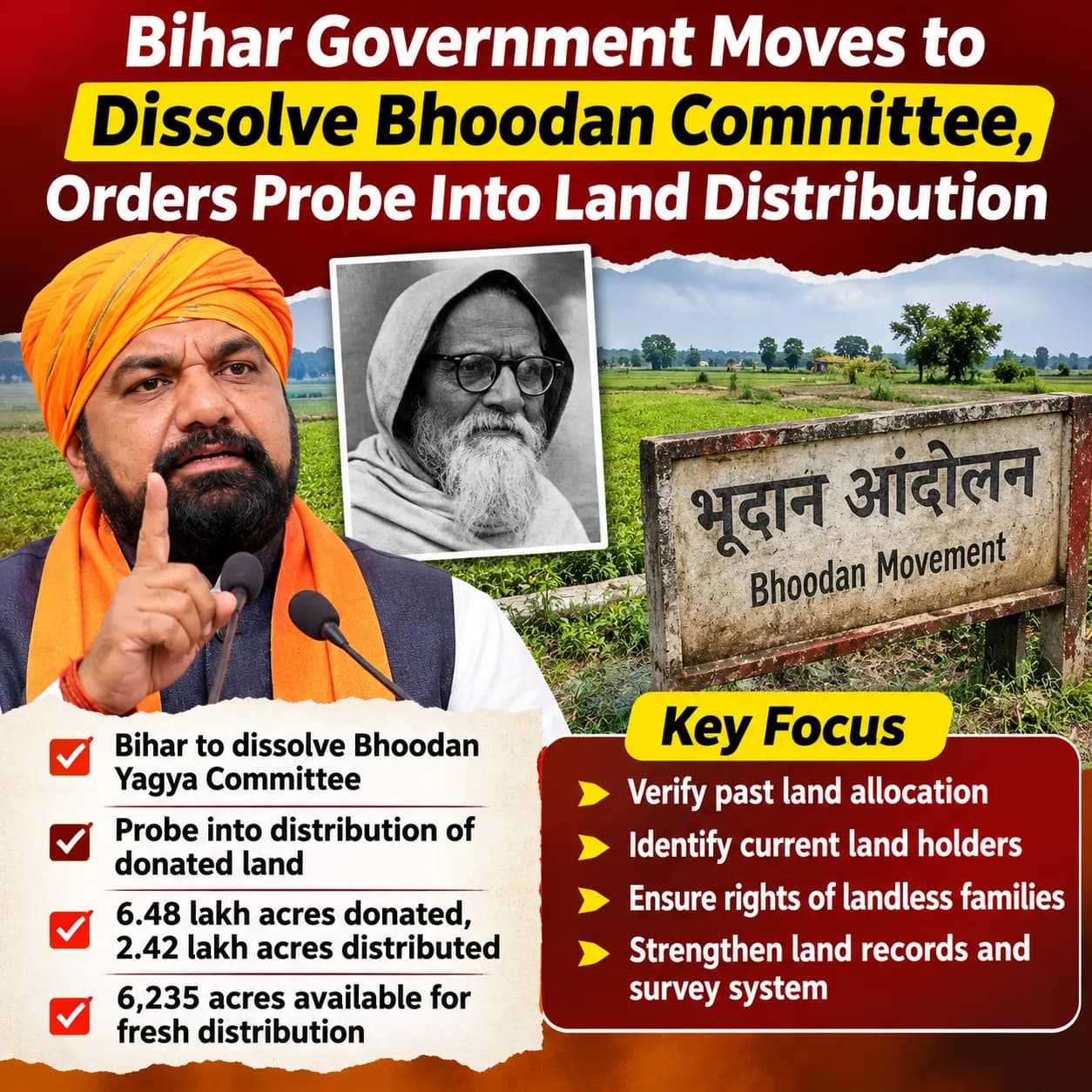
The Bihar government has initiated a major step towards reviewing decades-old land distribution under the historic Bhoodan movement, announcing its decision to dissolve the Bihar Bhoodan Yagya Committee and order a comprehensive investigation into the allocation of donated land.
The decision was announced on November 18 by Revenue and Land Reforms Minister Dilip Kumar Jaiswal.
The government has raised concerns over possible irregularities in the distribution of land collected under the movement initiated by Acharya Vinoba Bhave.
The investigation will examine whether land donated by former zamindars and landowners actually reached landless and economically disadvantaged families or was diverted towards other purposes.
What Was the Bhoodan Movement?
The Bhoodan movement was initiated by Acharya Vinoba Bhave with the objective of encouraging landowners to voluntarily donate land for distribution among landless families.
The movement became an important chapter in India's social and rural reform history.
Bihar was among the states where the movement received considerable support.
According to figures shared by the state government, approximately 6.48 lakh acres of land were donated under the movement.
However, the government has indicated that the process of identifying, recording and distributing the donated land was not completed satisfactorily in several cases.
Government Identifies Questions Over Land Distribution
According to Revenue Minister Dilip Kumar Jaiswal, the committee had confirmed approximately 3.46 lakh acres out of the total donated land.
Of this, around 2.42 lakh acres were distributed through district-level branches to landless and needy families, as well as for government purposes.
The minister also stated that approximately 6,235 acres remained available for immediate distribution.
These figures have raised important questions about the remaining land and the actual status of previously distributed properties.
The government wants to determine who currently occupies these parcels and whether the original beneficiaries received the land legally.
Why Has the Government Decided to Dissolve the Committee?
The government's decision reflects concerns about the functioning of the committee and the need for a fresh assessment of the land distribution system.
Rather than relying entirely on decades-old records, the administration intends to examine the available documentation and actual ground situation.
The investigation could help identify discrepancies between official records and present land possession.
It could also reveal cases where intended beneficiaries never received effective possession of the land.
However, the government's announcement should not be interpreted as proof that all previous land allocations were illegal. The purpose of the investigation is to establish the facts.
Land Survey Recruitment Also Gets Attention
Alongside the Bhoodan Committee decision, the Revenue and Land Reforms Department announced progress towards strengthening the state's land survey machinery.
The government has reportedly sent requisitions for 3,310 posts to the concerned recruitment agency.
These include:
96 Assistant Settlement Officers.
414 Kanungos.
2,609 Ameens.
191 Clerks.
The recruitment drive is expected to strengthen the state's special land survey programme and improve administrative capacity.
The move is particularly important in Bihar, where land disputes, incomplete records and ownership-related disagreements have remained significant governance challenges.
Political Implications: Land Rights Become a Major Governance Issue
The decision could have considerable political consequences because land ownership remains a sensitive issue across rural Bihar.
For landless families, the Bhoodan movement represented the promise of economic security and access to agricultural resources.
If the investigation identifies irregularities, the government could face pressure to ensure that genuine beneficiaries receive their rightful land.
The opposition may also question why the alleged irregularities remained unaddressed for decades.
At the same time, the government will need to ensure that genuine beneficiaries are not unnecessarily disturbed during the verification process.
What Happens Next?
The most important next step will be the actual investigation of the donated land.
The government will need to establish accurate records, identify present occupants and verify whether the original distribution orders were followed.
The outcome could influence future land reform decisions and the administration of rural property records.
Conclusion
The decision to dissolve the Bihar Bhoodan Yagya Committee marks a significant development in the state's land administration.
By ordering an investigation into land distribution, the Samrat Choudhary government has placed decades-old land records under renewed scrutiny.
The real test, however, will be whether the investigation ensures justice for genuine landless beneficiaries and improves transparency in Bihar's land governance system.