
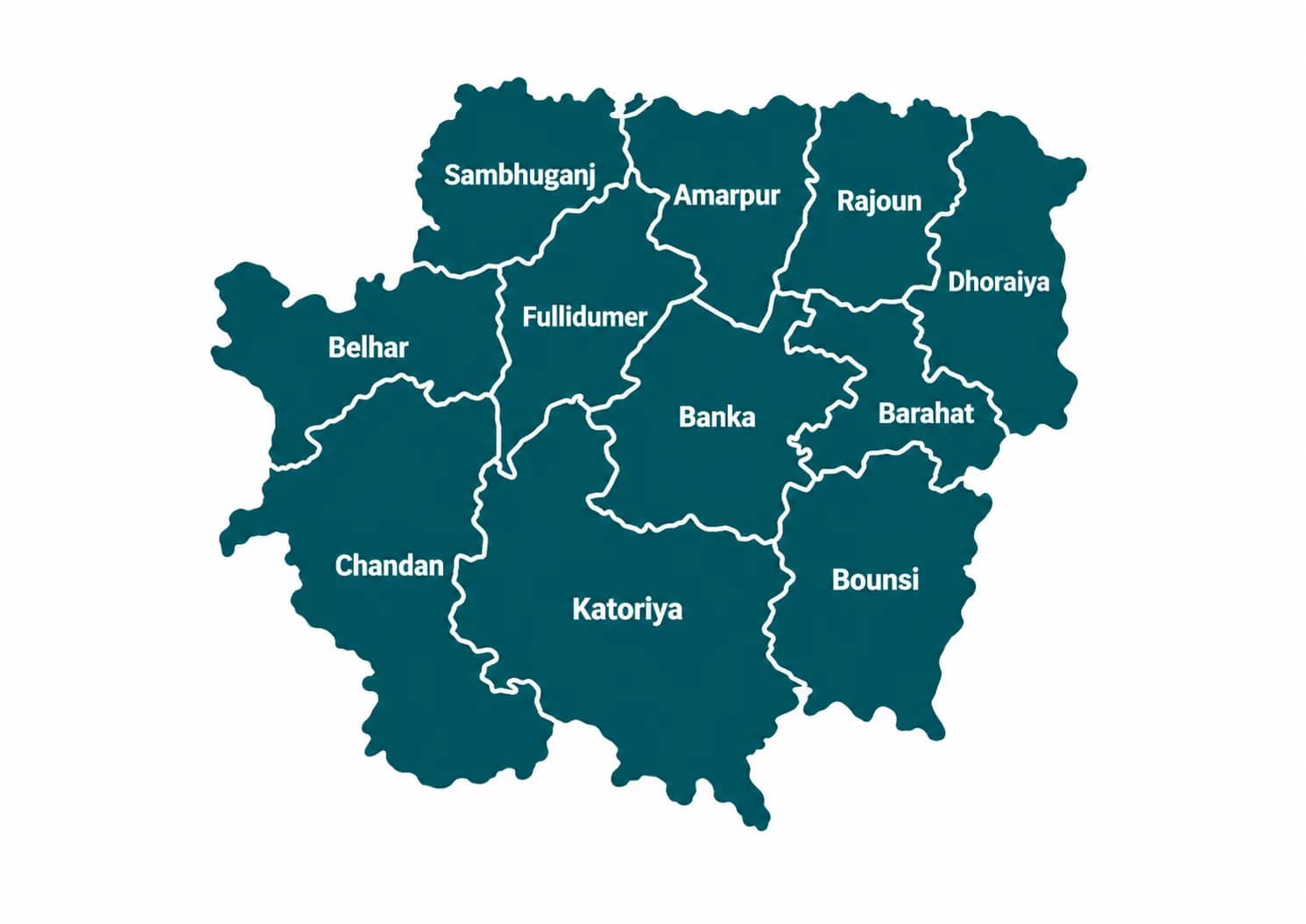
Banka
Banka is a southeastern district of Bihar bordering Jharkhand. It is known for Mandar Hill, its agricultural landscape, religious heritage and the annual Bounsi Mela.
- Headquarters
- Banka
- Division
- Bhagalpur Division
- Established
- 1991
- Area
- 3,019.35 sq km
- Population
- 2,034,763 (2011)
- Lok Sabha
- Banka
- Vidhan Sabha
- Amarpur | Dhoraiya (SC) | Banka | Katoriya (ST) | Belhar
Banka District, Bihar
Overview
Banka is a district situated in the southeastern part of Bihar and forms part of Bhagalpur Division. Banka town is the district headquarters. The district is known for its natural landscape, religious heritage, agricultural activities and geographical proximity to Jharkhand.
One of its most recognised landmarks is Mandar Hill, a historically and religiously significant site located near Bounsi.
History and Heritage
Banka was historically part of Bhagalpur district and functioned as a subdivision before becoming an independent district.
The district was established on 21 February 1991 to improve administrative management and public service delivery in the region.
Banka has a rich cultural background connected with the historical traditions of southeastern Bihar. Mandar Hill is associated with religious traditions described in Hindu mythology and is an important destination for pilgrims.
Geography and Administration
Banka covers approximately 3,019.35 square kilometres and belongs to Bhagalpur Division. It lies in the southeastern corner of Bihar and shares its eastern and southern boundaries with Godda district of Jharkhand.
The district is bordered by Jamui and Munger districts towards the west and northeast, while Bhagalpur lies to its north.
Banka has eleven administrative blocks: Amarpur, Banka, Barahat, Belhar, Bounsi, Chandan, Dhoraiya, Phulidumar, Katoriya, Rajoun and Shambhuganj.
Population and Demographics
According to the Census of India 2011, Banka district had a population of 2,034,763.
The district recorded a population density of approximately 670 people per square kilometre, a sex ratio of 907 females per 1,000 males and a literacy rate of approximately 58.17%.
Hindi and Angika are among the languages used in the district. A substantial proportion of its population lives in rural communities.
Economy and Agriculture
Agriculture is an important part of Banka's economy. Paddy, wheat, maize and other seasonal crops are cultivated in the district.
Local markets, livestock rearing, small businesses and agricultural trade support rural livelihoods. The district's agricultural economy is influenced by seasonal rainfall, irrigation facilities and the availability of cultivable land.
Mandar Hill and other religious destinations also contribute to tourism-related economic activity.
Political Significance
Banka is represented in the Lok Sabha through the Banka parliamentary constituency.
The district has five Bihar Legislative Assembly constituencies: Amarpur, Dhoraiya (Scheduled Caste), Banka, Katoriya (Scheduled Tribe) and Belhar.
The Banka parliamentary constituency also includes Sultanganj Assembly constituency from neighbouring Bhagalpur district. This distinction is important when recording district-level and parliamentary constituency information.
Culture and Tourism
Mandar Hill, also known as Mandar Parvat, is one of the most recognised attractions in Banka. It is associated with the Samudra Manthan legend and has religious significance for Hindu and Jain communities.
The Bounsi Mela is an important annual fair held near Mandar Hill, traditionally beginning around Makar Sankranti in January.
Other religious sites, local temples and traditional festivals contribute to the district's cultural identity.
Education and Healthcare
Banka has government schools, colleges and educational institutions serving students across its administrative blocks.
Public healthcare is provided through government hospitals, community health centres and primary health centres. Access to specialised healthcare and higher education remains important for residents of rural areas.
Transport and Connectivity
Banka is connected to Bhagalpur, Jamui, Munger and neighbouring districts through road networks. Railway services also support passenger movement and regional connectivity.
Its location near the Jharkhand border makes road transportation important for trade, employment and access to neighbouring towns.
Development and Urban Growth
Agricultural infrastructure, irrigation, rural roads, healthcare, education and tourism development are important priorities for Banka.
Improving transport links and promoting Mandar Hill and other cultural destinations offer opportunities for regional economic growth.
Banka District Today
Banka remains an important district of southeastern Bihar because of its geographical position, agricultural economy and cultural heritage. Mandar Hill and the Bounsi Mela continue to contribute to its religious and tourism identity, while its administrative headquarters supports public services across the district.