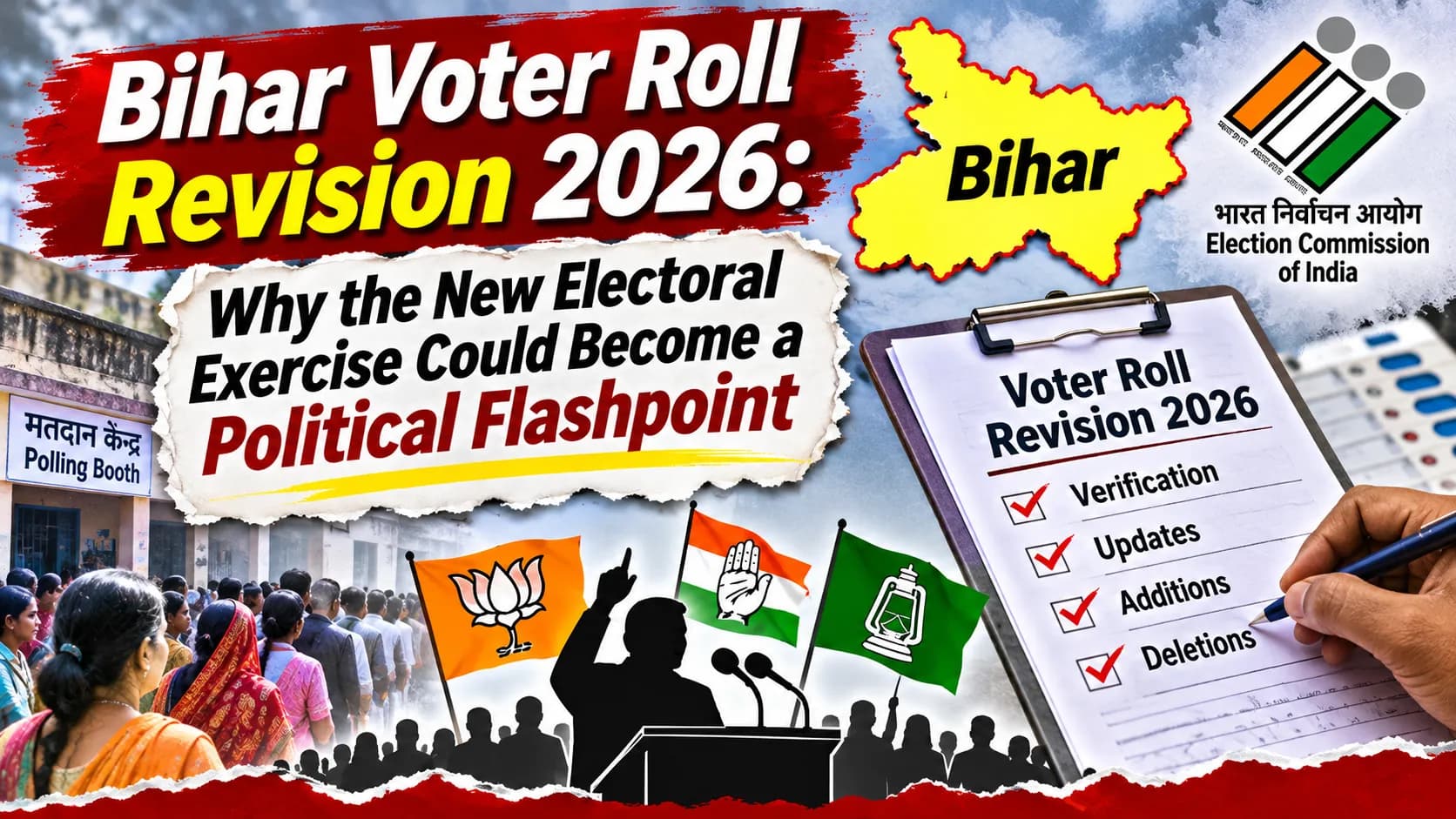
Bihar Voter Roll Revision 2026: Why the New Electoral Exercise Could Become a Political Flashpoint
The Election Commission's latest electoral roll revision exercise in Bihar has entered an important stage, bringing voter registration and electoral transparency back into the state's political discussion.
The Special Summary Revision, with January 1, 2027 as the qualifying date, began its scheduled process with the publication of integrated draft electoral rolls on November 12, 2026.
Although the exercise is administrative in nature, electoral roll revisions often attract political attention because they determine the registered electorate in each constituency.
For Bihar's political parties, the process provides an opportunity to monitor voter registration and raise concerns through the prescribed procedures. For citizens, it is an opportunity to check whether their details are correctly recorded.
What is happening in Bihar?
The Election Commission's October 15 communication directed the conduct of Special Summary Revision in Bihar and several other states.
The official schedule provides for publication of the integrated draft electoral rolls on November 12, followed by a period for filing claims and objections from November 12 to December 11, 2026.
The disposal of claims and objections is scheduled by December 28, while final publication of the revised electoral rolls is scheduled for January 4, 2027.
These dates are important because the revision process is not completed with the publication of the draft list. Citizens still have an opportunity to raise eligible claims and objections within the prescribed period.
Why are political parties interested?
Electoral rolls are central to the functioning of elections. They identify registered voters and help determine who can participate in voting in a particular constituency.
Political parties therefore monitor the revision process, especially when questions arise about missing names, duplicate entries or incorrect personal information.
However, any claim of large-scale deletion or irregularity should be supported by verifiable records. Political allegations alone cannot establish that an electoral violation has occurred.
Why should ordinary voters check their names?
A citizen may have a voter ID card but still need to verify that their name appears correctly in the relevant electoral roll.
Changes in residence, spelling errors, missing entries and other discrepancies can create difficulties if they are not addressed before the final roll is published.
Eligible citizens should check the draft electoral roll and use the appropriate official process to submit corrections or applications.
The importance of claims and objections
The claims and objections period is an important part of the revision process.
It allows citizens to seek inclusion where they are eligible, request corrections and raise objections where the prescribed grounds apply.
Election authorities are responsible for examining these submissions and taking decisions under the applicable rules.
This process should be transparent, accessible and supported by proper verification so that eligible voters are not unfairly excluded.
Why this issue could become politically sensitive
Electoral roll revisions can become contentious when parties disagree over the number of voters included, excluded or corrected.
In Bihar, political parties have previously raised concerns around electoral roll changes and the implications for voter participation.
The latest exercise should therefore be followed through official figures and documented decisions rather than assumptions about its political impact.
What happens next?
The most important dates for citizens are the December 11 deadline for claims and objections, December 28 deadline for their disposal and January 4 final publication.
Political parties, civil society organisations and voters can monitor the process during this period.
The quality of the exercise will depend on accurate records, accessible grievance procedures and fair examination of applications.
An accurate electoral roll is not merely an administrative requirement. It is a foundation of democratic participation, and every eligible voter should have the opportunity to verify their registration.