Bihar Legislative Council Rejects Disqualification Petitions Against MLCs Banshidhar Brajwasi and Rahul Raj
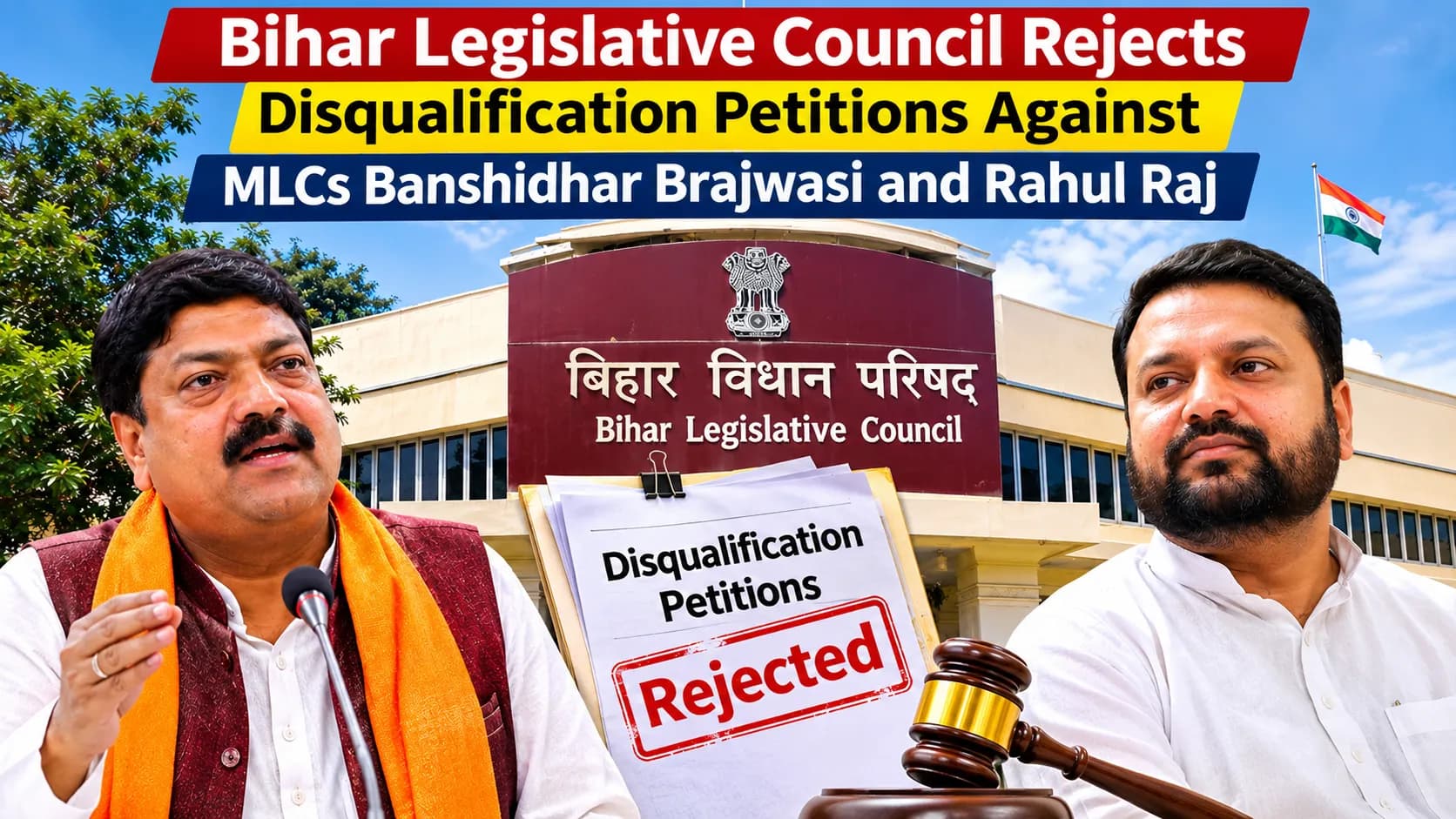
The Bihar Legislative Council Secretariat has rejected petitions seeking the disqualification of two independent Members of the Legislative Council (MLCs), Banshidhar Brajwasi and Rahul Raj, over allegations that they joined or associated themselves with the Bharatiya Janata Party (BJP) after winning their seats as Independents.
The petitions were filed by leaders associated with the Rashtriya Janata Dal (RJD) and Jan Suraaj. They sought action under the anti-defection provisions of the Constitution's Tenth Schedule.
However, the Council Secretariat reportedly found that the applications did not satisfy the prescribed requirements under the Bihar Legislative Council Members (Disqualification on Ground of Defection) Rules, 1994.
The rejection means that the petitions were not accepted for consideration at the preliminary stage. It should not be interpreted as a detailed judicial finding on every allegation concerning the two MLCs.
Why Were the Two MLCs Facing Disqualification Petitions?
Banshidhar Brajwasi and Rahul Raj won their respective seats in the 2026 Bihar Legislative Council elections as independent candidates.
Brajwasi was elected from the Tirhut Graduates' constituency, while Rahul Raj won from the Saran Teachers' constituency.
Their reported association with the BJP became a political issue after their appearance at the party's state headquarters in Patna and subsequent political developments.
Opposition leaders argued that their political activities should be examined under the anti-defection provisions applicable to independent legislators.
The RJD and Jan Suraaj subsequently approached the Council Secretariat seeking action against the two MLCs.
What Did the Legislative Council Secretariat Decide?
According to reports, Deputy Secretary Manoj Kumar issued separate communications on November 13, 2026, following directions from the Acting Chairman.
In the petition concerning Banshidhar Brajwasi, the Secretariat reportedly cited deficiencies under Rules 6 and 7 of the 1994 disqualification rules.
The application was found to have issues concerning the prescribed format, affidavits and supporting documents required under the rules.
The Secretariat therefore treated the petition as not maintainable at the preliminary stage.
In the case involving Rahul Raj, the question of the petitioners' legal standing was also raised. Reports stated that a disqualification petition under the relevant rules must be initiated by a sitting member of the Legislative Council.
The Secretariat consequently rejected the applications without proceeding to a full examination of the allegations.
Who Filed the Petitions?
Several RJD leaders were reported to have filed a petition concerning the two MLCs. The names mentioned in reports include Abdul Bari Siddiqui, Dr Sunil Kumar Singh, Shashi Yadav, Rajiv Kumar and Afaq Ahmad.
A separate group associated with Jan Suraaj also approached the Council Secretariat. Former MLA and Jan Suraaj leader Kishor Kumar was among the applicants mentioned in reports.
The objections raised by the Secretariat focused on procedural requirements and the eligibility of applicants to initiate proceedings under the relevant rules.
Why the Decision Matters for Bihar Politics
The decision marks a procedural development in the dispute concerning the two independent MLCs.
It also highlights the distinction between a political allegation, a request for disqualification and a formal decision under constitutional provisions.
The Tenth Schedule deals with disqualification on grounds of defection. However, proceedings under it must follow the applicable rules and prescribed procedures.
A petition rejected on procedural or maintainability grounds should not automatically be described as a finding that the underlying political allegations were false.
For the RJD and Jan Suraaj, the immediate outcome is that their applications have not proceeded to a full consideration through these petitions. For Brajwasi and Rahul Raj, their membership has not been cancelled through the applications decided at this stage.
What Happens Next?
The latest reported decision concerns the rejection of the petitions at the preliminary stage.
Any further legal or political action would depend on the steps available under the applicable rules and decisions of the concerned authorities.
The episode is likely to remain relevant to discussions about independent legislators, party association and the operation of anti-defection rules in Bihar.
For now, the two MLCs continue as members of the Legislative Council, while the Secretariat's decision has closed the particular petitions that were found procedurally deficient.