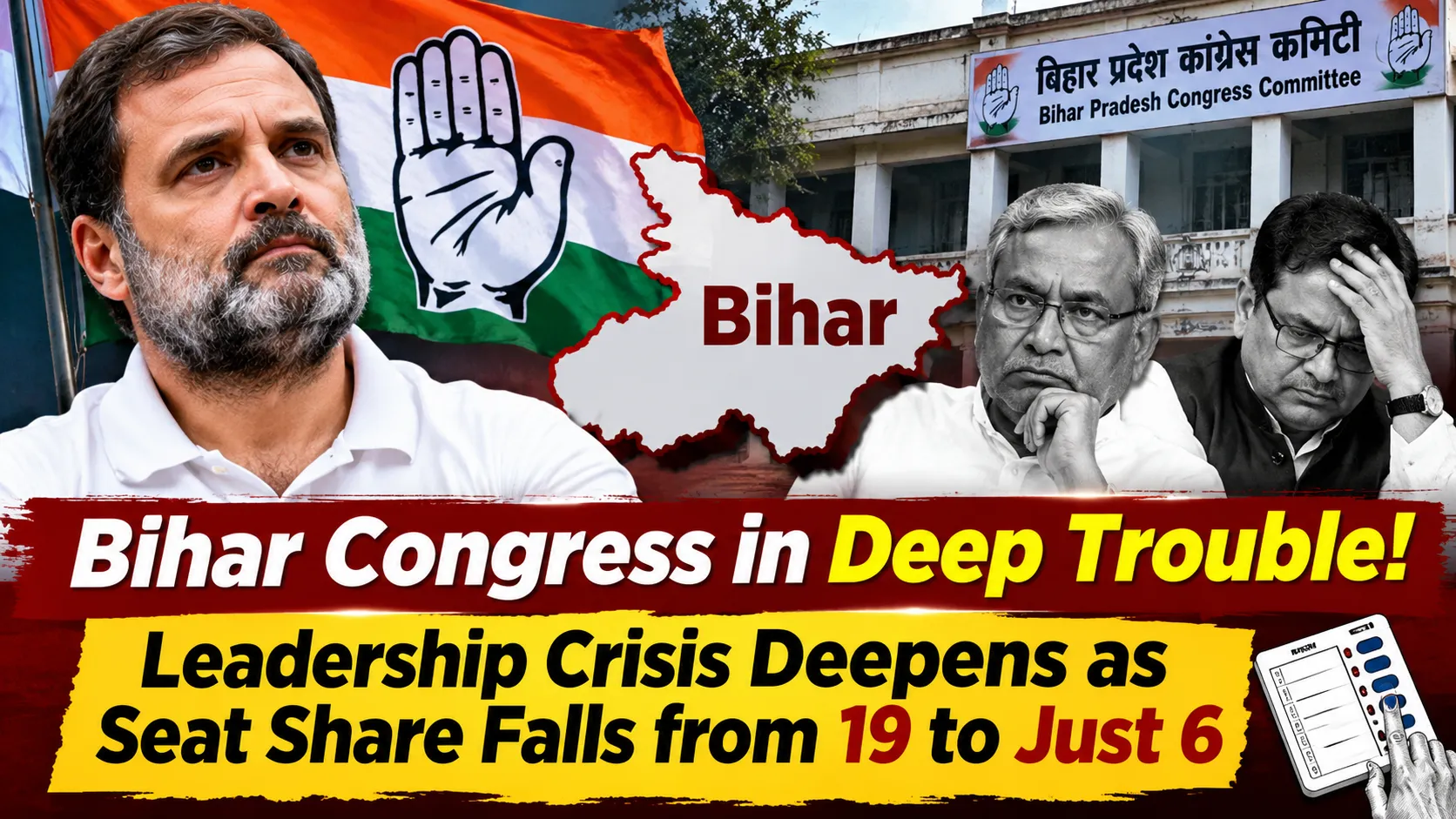
Bihar Congress in Deep Trouble! Leadership Crisis Deepens After Election Seat Share Falls from 19 to Just 6
Congress Faces a Difficult Political Battle in Bihar
The Bihar Congress is facing a fresh organisational challenge following its poor performance in the Assembly elections.
A report published on November 21, 2026, highlighted the difficulties confronting the party after its Assembly seat share fell from 19 to just six.
The decline has renewed questions about the party's leadership, organisational structure and ability to rebuild its political influence in Bihar.
For Congress, the challenge is not simply about winning elections. It is about restoring its identity as a serious political force in a state where regional parties and the BJP-led NDA dominate much of the political competition.
From 19 Seats to Six: What Changed?
The fall from 19 seats to six represents a major setback for the Bihar Congress.
Electoral performance is one of the most important indicators of a political party's organisational strength.
A reduced legislative presence can affect a party's visibility, political bargaining power and ability to influence public debates.
The latest situation has placed the Bihar leadership under pressure to explain what went wrong and how the party intends to recover.
The decline also raises questions about candidate selection, campaign strategy, grassroots organisation and coordination with political allies.
Leadership Becomes the Central Question
The immediate challenge for Congress is organisational clarity.
A political party needs leadership that can coordinate district-level workers, communicate its policies and maintain contact with voters between elections.
When electoral performance weakens, questions about leadership naturally become more prominent.
The Bihar Congress now faces the difficult task of rebuilding confidence among its workers and supporters.
The party must also establish a clear political direction that distinguishes its campaign from those of its regional allies and opponents.
The NDA's Political Advantage
The BJP-led NDA government has an opportunity to strengthen its position while the opposition struggles with organisational questions.
Chief Minister Samrat Choudhary's government can use the opposition's difficulties to reinforce its political messaging.
However, Congress's organisational problems do not automatically guarantee long-term electoral success for the ruling alliance.
The government will still face scrutiny over employment, law and order, public services and development.
A strong democracy requires an opposition capable of questioning the government and presenting credible alternatives.
Can Congress Rebuild Its Grassroots Network?
Congress needs to focus on more than political statements and press conferences.
Its recovery will depend on rebuilding its organisation across districts and constituencies.
Some important challenges include:
Strengthening district-level party committees.
Giving younger leaders meaningful organisational responsibilities.
Improving communication between state leadership and grassroots workers.
Developing a consistent political position on major public issues.
Building stronger coordination with opposition allies.
Maintaining regular engagement with voters.
Without an active grassroots network, even a popular political message may fail to translate into electoral success.
The Alliance Question
Bihar politics has long involved complicated relationships between regional parties and national political organisations.
Congress must decide how it wants to position itself within the opposition's broader political framework.
An alliance can improve electoral prospects, but it also requires effective seat-sharing negotiations and organisational coordination.
The party must balance its relationship with allies while maintaining its own political identity.
This will be particularly important as opposition parties prepare for future electoral contests.
What Happens Next?
The immediate focus will be on whether the Bihar Congress undertakes meaningful organisational changes.
Leadership accountability, district-level restructuring and a renewed political campaign could become important elements of its recovery strategy.
The party's ability to reconnect with voters will determine whether it can reverse its declining political influence.
Conclusion
The Bihar Congress is facing a serious political challenge.
A reduction in Assembly representation from 19 to six has intensified questions about its leadership and organisational effectiveness.
The party now needs more than promises of revival. It needs a clear strategy, active grassroots workers and credible leadership.
For the opposition, rebuilding Congress could be an important part of strengthening the broader political challenge to the NDA in Bihar.