Banka–Jamui Mineral Blocks Auction: Bihar Cabinet Approves Major Mining Push Worth Over ₹5,000 Crore
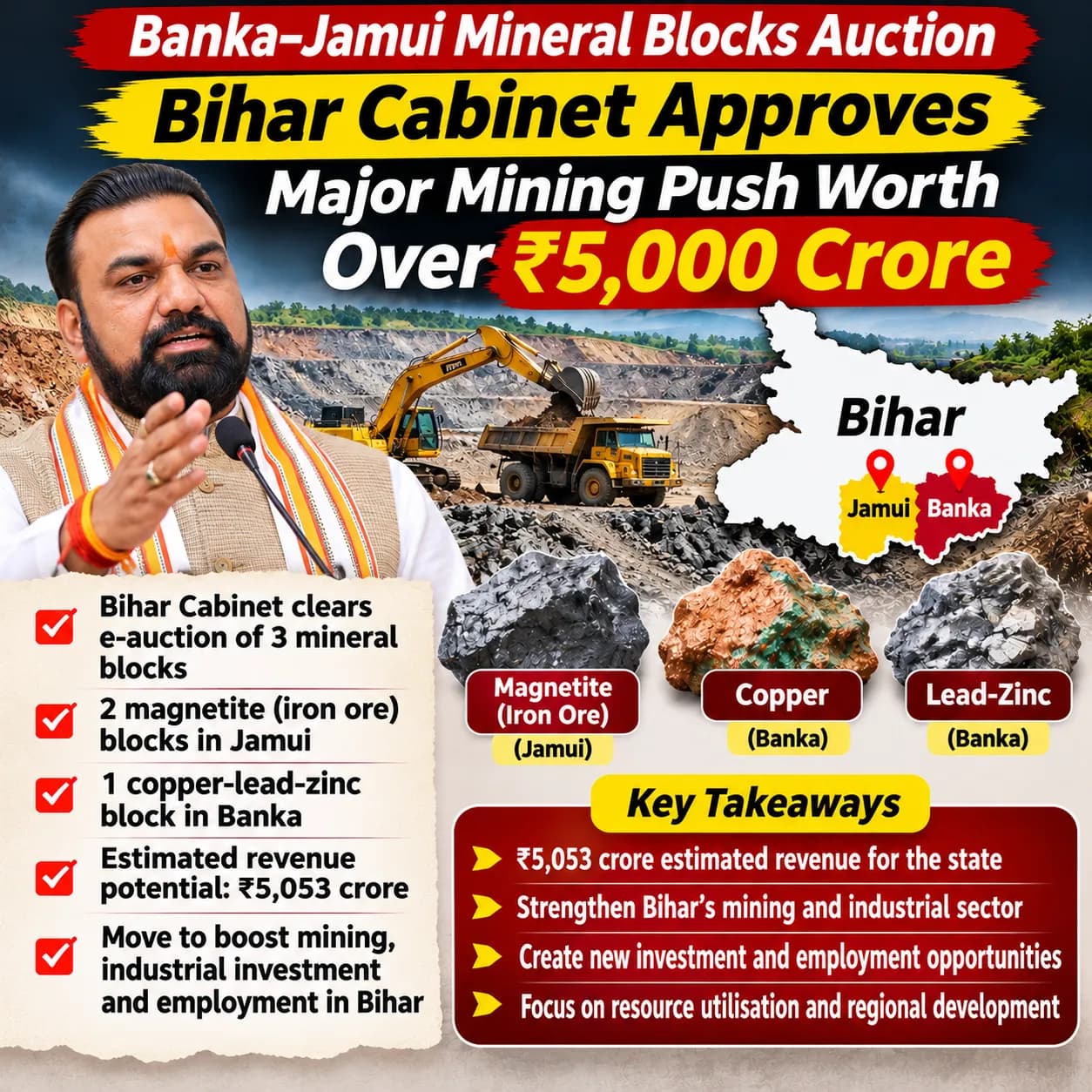
The Bihar government has taken an important step towards expanding the state's mining sector after the cabinet, chaired by Chief Minister Samrat Choudhary, approved the proposal for the e-auction of three mineral blocks located in Banka and Jamui districts.
The decision was taken on November 18, 2026, and is being viewed as an important development in the state's efforts to utilise its mineral resources for economic and industrial growth.
According to reports, the proposed auction of the mineral blocks could generate an estimated ₹5,053 crore for the state.
The cabinet's decision covers two magnetite (iron ore) blocks in Jamui district and one copper-lead-zinc block in Banka district.
The move has brought renewed attention to the mineral potential of Bihar, particularly in its southern districts.
Which Mineral Blocks Have Been Approved for Auction?
The cabinet-approved proposal covers three mineral blocks.
1. Majos Magnetite Block – Jamui
The Majos block in Jamui district contains magnetite, an important iron ore mineral used in the steel and iron industry.
Its commercial development could support industrial activity and create opportunities for investment in mineral-related sectors.
2. Bhanta Magnetite Block – Jamui
The Bhanta block is another magnetite deposit identified for the proposed e-auction.
Together, the two Jamui blocks could strengthen the state's position in the iron ore sector.
3. Pindara Copper-Lead-Zinc Block – Banka
The third block is located at Pindara in Banka district.
It contains copper, lead and zinc resources, minerals that have applications across manufacturing, electrical equipment, infrastructure and other industrial sectors.
The inclusion of these resources in the auction proposal makes the decision particularly significant for Bihar's mining development.
₹5,053 Crore Revenue Potential: A Major Economic Opportunity
The estimated ₹5,053 crore revenue potential is one of the most important aspects of the cabinet decision.
The proposed auction could provide the state with an opportunity to generate revenue through the commercial development of its mineral resources.
However, the estimated figure should not be confused with money already received by the government.
The actual revenue will depend on the auction process, successful bidders, mineral development and applicable financial arrangements.
The government has approved the process of moving towards the auction, including resource assessment, determination of reserve prices and the auction timeline.
These steps are necessary before the actual bidding process can take place.
Samrat Choudhary Government Focuses on Industrial Expansion
Chief Minister Samrat Choudhary has presented the decision as an important step towards strengthening Bihar's industrial and economic development.
The government's position is that better utilisation of mineral resources can encourage investment and create additional employment opportunities.
The proposed auction also reflects an effort to make the state's mineral wealth commercially productive.
Bihar has traditionally faced challenges in expanding its industrial base compared with several other Indian states.
The development of mineral resources could provide additional opportunities for industrial activity, particularly in regions with suitable infrastructure and investment potential.
What Could Banka and Jamui Gain?
For Banka and Jamui, the proposed mining development could bring significant economic opportunities.
If the auction results in successful commercial mining projects, the districts could benefit from increased economic activity.
Potential benefits include:
New investment in the mining sector.
Employment opportunities for local residents.
Development of transport and supporting infrastructure.
Growth of mineral-related industries.
Increased economic activity for local businesses.
Additional revenue opportunities for the state government.
Political Implications: Mining Becomes a Development Agenda
The cabinet decision has political significance for the Samrat Choudhary government.
The BJP-led administration can present the proposal as an example of its focus on industrial investment, resource utilisation and economic development.
For the ruling NDA, the challenge will be to demonstrate that the mineral auction translates into measurable benefits for Bihar.
The opposition may also scrutinise the auction process, transparency, environmental safeguards and the distribution of economic benefits.
The government will need to ensure that local communities are not excluded from the opportunities created by mineral development.
What Happens Next?
Following cabinet approval, the next steps will involve:
Assessment of mineral resources in the three blocks.
Determination of reserve prices.
Finalisation of the e-auction schedule.
Conduct of the bidding process.
Selection of successful bidders.
Further statutory and regulatory approvals for mining operations.
The auction process will determine how quickly the mineral resources can move towards commercial development.
Conclusion
The approval of the Banka and Jamui mineral block e-auction proposal marks an important development in Bihar's economic and industrial policy.
With an estimated revenue potential of ₹5,053 crore, the proposal could open new opportunities for mining investment and industrial expansion.
However, the real success of this initiative will depend on transparent auctions, responsible mineral extraction, local employment and effective implementation.
For the Samrat Choudhary government, the coming months will be important in converting cabinet approval into tangible economic results for Bihar.