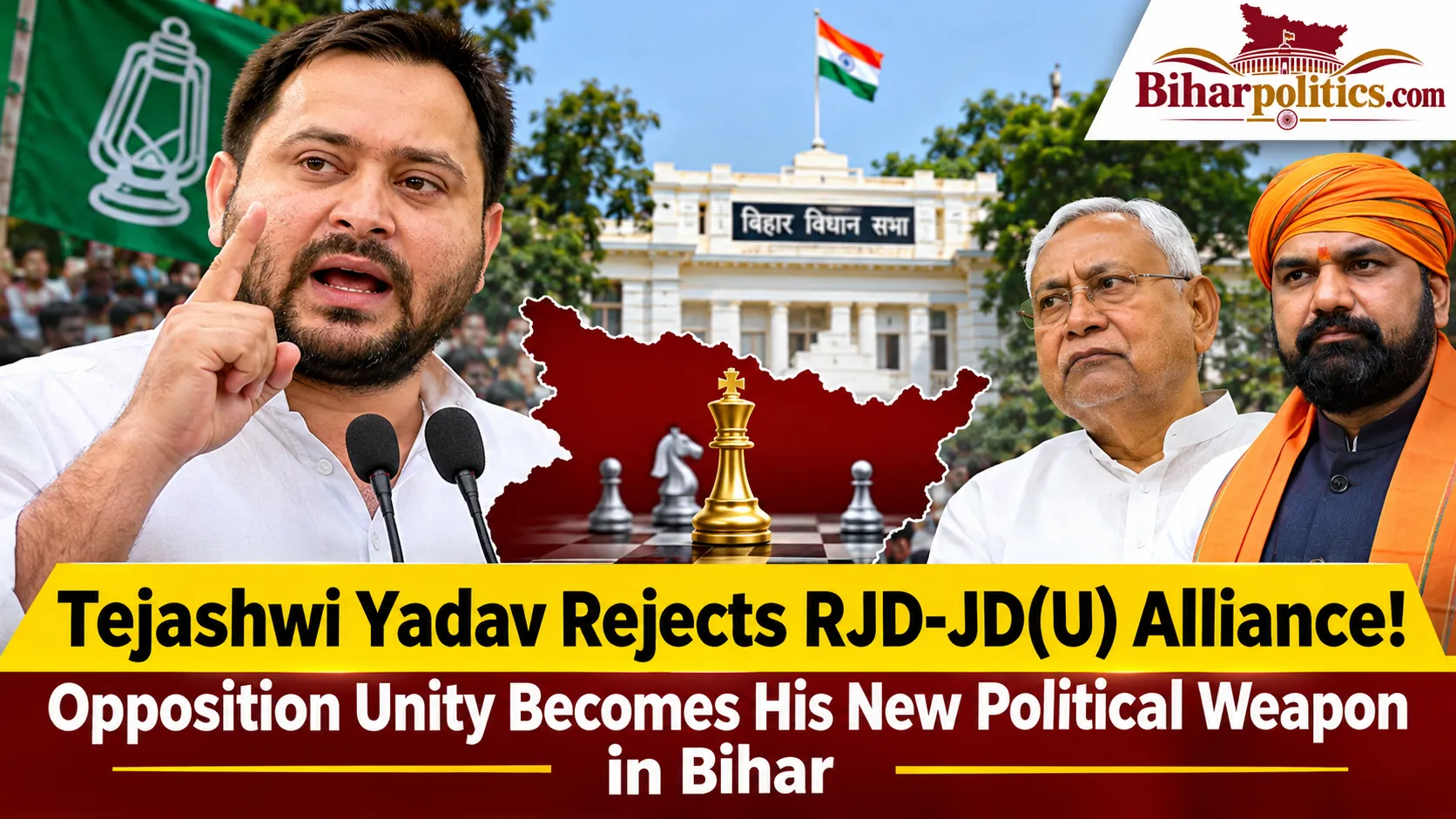
Tejashwi Yadav Rejects RJD-JD(U) Alliance! Opposition Unity Becomes His New Political Weapon as Bihar's Political Battle Intensifies
Introduction: Tejashwi Draws a Political Line
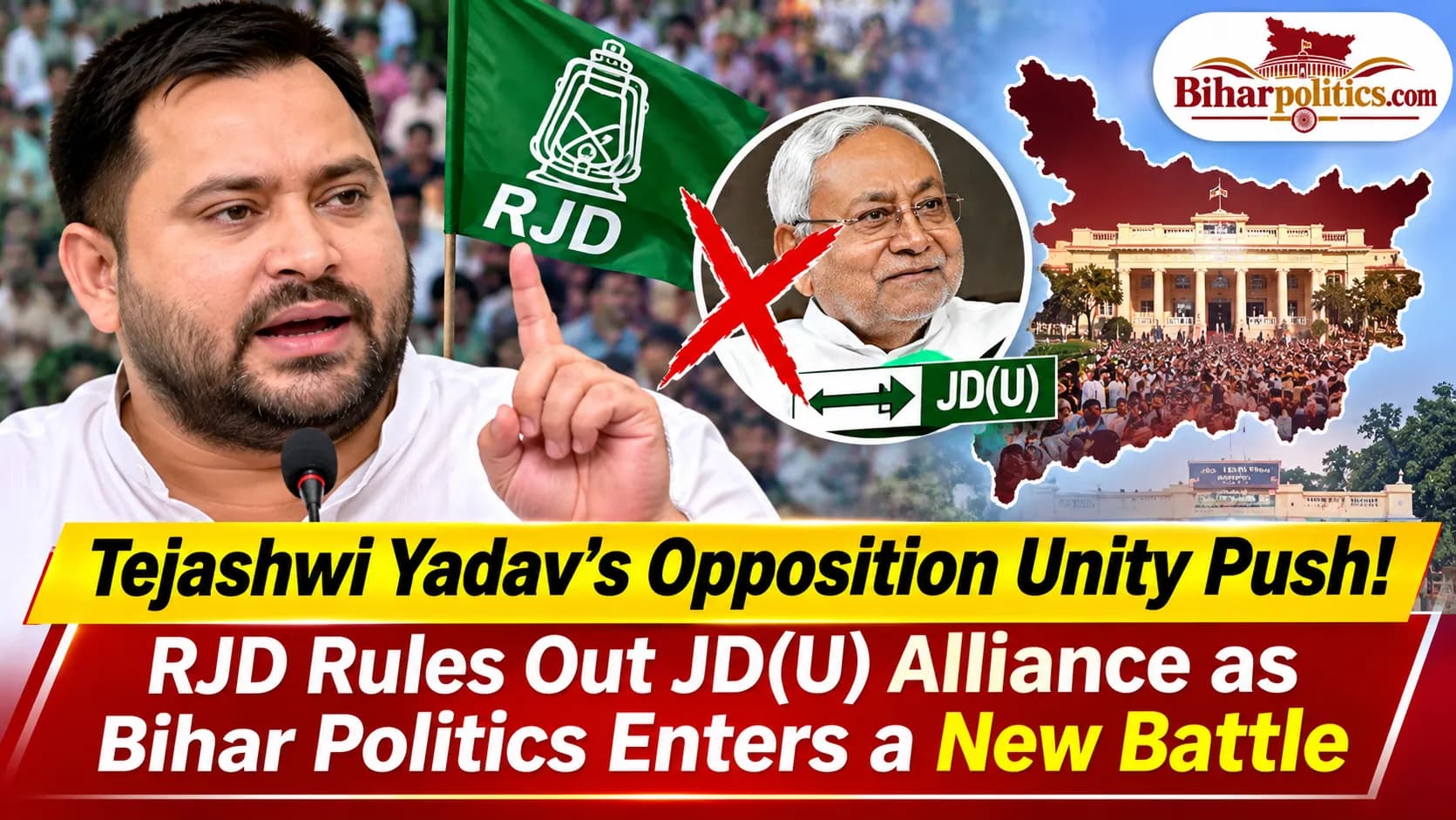
Bihar's political landscape is witnessing another significant development as Leader of Opposition Tejashwi Yadav has ruled out the possibility of an electoral alliance between the Rashtriya Janata Dal (RJD) and Janata Dal (United).
In an interview published on November 24, Tejashwi made it clear that his immediate political priority is strengthening the existing opposition alliance and expanding its outreach among the people.
His statement comes amid changing political equations in Bihar following the transition of leadership from Nitish Kumar to Chief Minister Samrat Choudhary.
The remarks are significant because JD(U) and RJD have previously shared power in Bihar, making the possibility of another political understanding a subject of speculation.
However, Tejashwi's latest position indicates that the RJD wants to focus on strengthening its current political partnerships rather than reopening the possibility of an alliance with JD(U).
RJD Rules Out Fresh Electoral Understanding With JD(U)
Tejashwi's statement sends a clear political message to Bihar's established political parties.
He emphasised that the RJD has remained committed to its alliances even during difficult political circumstances.
According to him, the party will continue strengthening its existing political partnerships and expanding its public outreach.
The statement effectively rejects speculation about a possible RJD-JD(U) electoral understanding.
For the ruling NDA, this position means that the opposition leadership is publicly maintaining a separate political direction.
The development also highlights the importance of alliance management in Bihar, where political combinations have frequently influenced electoral outcomes.
Special Category Status Returns to Bihar's Political Debate
Another major issue raised by Tejashwi was Bihar's long-standing demand for special category status.
The RJD leader reiterated that the demand remains important for the state's development.
Special category status has historically been a significant political and economic issue in Bihar.
Supporters of the demand argue that the state requires additional financial assistance and development support because of its economic challenges.
The issue has repeatedly featured in political discussions involving the central government and successive Bihar governments.
By raising it again, Tejashwi is attempting to keep economic development and financial support at the centre of the opposition's political agenda.
The demand also provides the opposition with an opportunity to question the ruling establishment about Bihar's economic priorities.
Police Accountability Becomes Another Political Flashpoint
Tejashwi also criticised the functioning of the Bihar police system.
He argued that accountability must be strengthened and that citizens should feel confident that their grievances are taken seriously.
He further emphasised that the police should not function as a political instrument against opposition parties.
The remarks add another dimension to the ongoing political debate over law and order in Bihar.
Police reforms, public safety, institutional independence and accountability remain important subjects in state politics.
For the RJD, these issues could become significant political talking points when questioning the Samrat Choudhary-led government.
However, the opposition will also face the challenge of presenting a credible alternative approach to policing and public safety.
Samrat Choudhary Government Faces Political Questions
The leadership transition in Bihar has created a new political environment.
With Samrat Choudhary serving as Chief Minister, the BJP-led NDA government faces the task of establishing its political identity and demonstrating administrative performance.
The RJD, meanwhile, is attempting to strengthen its opposition position.
Tejashwi's latest remarks suggest that the party wants to concentrate on three broad areas:
Strengthening opposition unity.
Raising economic development and special category status.
Questioning the government's approach to law and order.
These issues could shape the opposition's political messaging in the coming months.
Political Implications: What Does Tejashwi's Statement Mean?
Tejashwi's rejection of an RJD-JD(U) alliance has several political implications.
For the RJD: The party is signalling that it wants to consolidate its existing opposition partnerships.
For JD(U): The possibility of a fresh electoral understanding with RJD has been publicly rejected by Tejashwi.
For the BJP: The opposition's strategy will remain a factor in the government's political calculations.
For Bihar's voters: Economic development, police accountability and social justice are likely to remain important political issues.
What Happens Next?
The coming political developments will determine whether the opposition can translate its unity message into stronger organisational coordination.
The RJD will also need to demonstrate how its demands on economic development and policing can be converted into practical policy proposals.
Meanwhile, the Samrat Choudhary government will face questions over employment, infrastructure, public safety and economic opportunities.
Conclusion: Bihar's Opposition Signals a Separate Political Road
Tejashwi Yadav's latest statement is more than a rejection of a possible RJD-JD(U) alliance.
It reflects the RJD's attempt to establish a clear political direction under the changing leadership structure in Bihar.
By prioritising opposition unity, special category status and police accountability, Tejashwi is seeking to keep the focus on governance and social justice.
The political question now is whether the opposition can turn this message into a stronger political challenge against the ruling NDA.