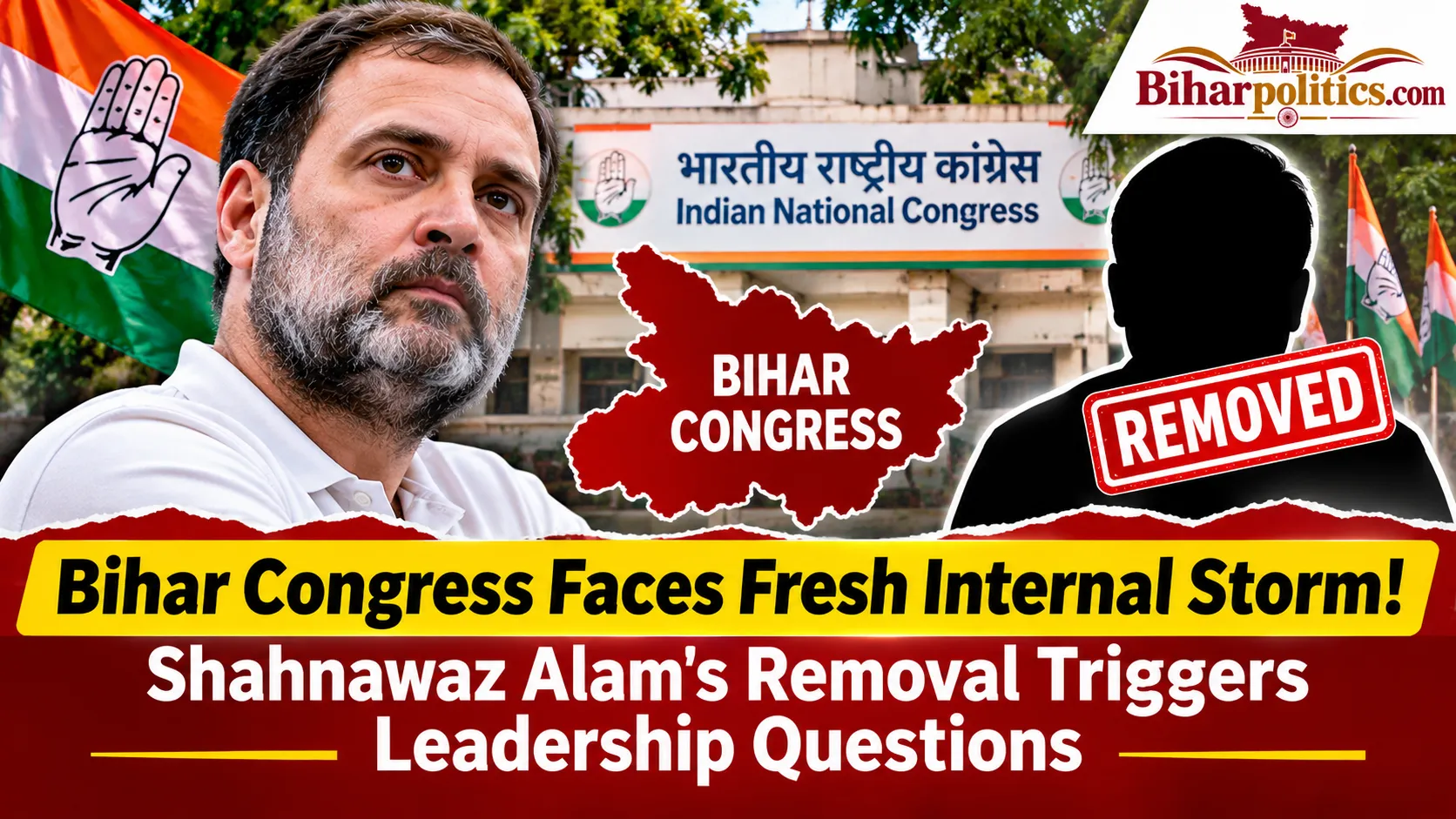
Bihar Congress Faces Fresh Internal Storm! Shahnawaz Alam's Removal Triggers Leadership Questions as Party Struggles to Rebuild Its Organisation
Introduction: Congress Faces Another Organisational Challenge
Bihar Congress is facing fresh questions over its organisational direction following the recent reshuffle of the All India Congress Committee (AICC).
The removal of Shahnawaz Alam from his responsibility as an AICC secretary assigned to Bihar has reportedly disappointed several party leaders in the state.
The development has become a subject of internal discussion, with some Congress leaders expressing concern about the decision.
The political significance of this development goes beyond an individual organisational appointment.
Congress is attempting to strengthen its position in Bihar, where the party must compete against established political formations and rebuild its organisational presence.
Shahnawaz Alam's Exit Becomes a Talking Point
According to reports, several Bihar Congress leaders were unhappy with Shahnawaz Alam being relieved of his responsibility as AICC secretary assigned to the state.
Some leaders reportedly considered him accessible and believed his presence had helped maintain communication within the organisation.
The reported dissatisfaction suggests that the reshuffle has not been welcomed uniformly across the Bihar Congress unit.
Some leaders are reportedly considering raising their concerns with the party high command.
However, the reported internal dissatisfaction should not automatically be interpreted as a formal revolt against the national leadership.
Congress Appoints Three New AICC Secretaries for Bihar
The wider organisational reshuffle has brought three new AICC secretaries into the Bihar assignment.
The newly assigned leaders are:
Pradeep Narwal
Professor Prakash Sonawane
Mahboob Pasha
The appointments were announced as part of the Congress leadership's wider organisational restructuring.
These leaders will be responsible for organisational work and coordination in Bihar.
Their responsibilities include strengthening the party structure and supporting its political activities in the state.
The appointments represent an attempt by the Congress high command to reorganise its state-level leadership arrangements.
Bihar Congress Leaders Get Responsibilities Outside the State
The reshuffle also gave new national responsibilities to two Bihar Congress leaders.
Ajay Kumar Paswan was assigned responsibility in Madhya Pradesh, while former Bihar Youth Congress president Gunjan Patel received an organisational responsibility in West Bengal.
These changes indicate that the Congress is redistributing organisational responsibilities across several states.
For Bihar Congress, the challenge will be to maintain a strong local structure while some familiar leaders take up assignments elsewhere.
The party will need to ensure that state-level coordination remains effective during this transition.
Why This Matters for Bihar Politics
Congress remains an important component of Bihar's opposition politics.
Its organisational strength can influence the effectiveness of the broader opposition alliance.
However, political alliances alone cannot guarantee organisational success.
A party also needs active district-level leadership, regular communication with workers, a clear political message and a strong connection with voters.
The latest controversy highlights the importance of these internal factors.
If dissatisfaction continues among state-level leaders, it could make the organisational rebuilding exercise more difficult.
On the other hand, if the new AICC team establishes effective coordination, the reshuffle could provide the party with an opportunity to reorganise its political machinery.
Rahul Gandhi and the Congress High Command Face an Organisational Test
The latest developments also put the Congress high command's organisational decisions under scrutiny.
The national leadership has been undertaking changes across several states as part of its broader restructuring exercise.
In Bihar, the key challenge is to balance organisational changes with the expectations of established state leaders.
The leadership will need to ensure that new appointments are accepted by local workers and that responsibilities are clearly defined.
For the Congress, rebuilding its organisation requires more than announcing new appointments.
It requires consistent political activity, local leadership development and stronger coordination between state and national units.
Political Implications: Can Congress Strengthen Its Position?
The latest reshuffle creates both opportunities and challenges.
For the Congress high command: The new appointments provide an opportunity to restructure the Bihar organisation.
For existing state leaders: The changes raise questions about coordination and representation in organisational decisions.
For the opposition alliance: A stronger Congress organisation could improve the wider opposition's political capacity.
For the ruling NDA: Any organisational weakness within opposition parties could affect the balance of political competition in Bihar.
However, the real impact of the reshuffle cannot be determined by appointments alone.
What Happens Next?
Attention will now turn towards the functioning of the newly appointed AICC secretaries and the response of the Bihar Congress leadership.
The party will need to address internal concerns while concentrating on its political priorities.
Its immediate organisational tasks include strengthening district units, improving communication with workers and developing a consistent political strategy.
Whether the new leadership arrangement can bring greater coordination or create further disagreements remains to be seen.
Conclusion: Organisational Unity Is Congress's Biggest Test
The removal of Shahnawaz Alam from his Bihar responsibility has exposed questions about internal coordination within the Congress organisation.
The appointment of three new AICC secretaries represents a fresh attempt to strengthen the party's state-level structure.
But organisational restructuring can succeed only when leadership decisions are supported by effective coordination and grassroots participation.
For Bihar Congress, the coming months will be an important test of whether the reshuffle can translate into stronger political organisation.