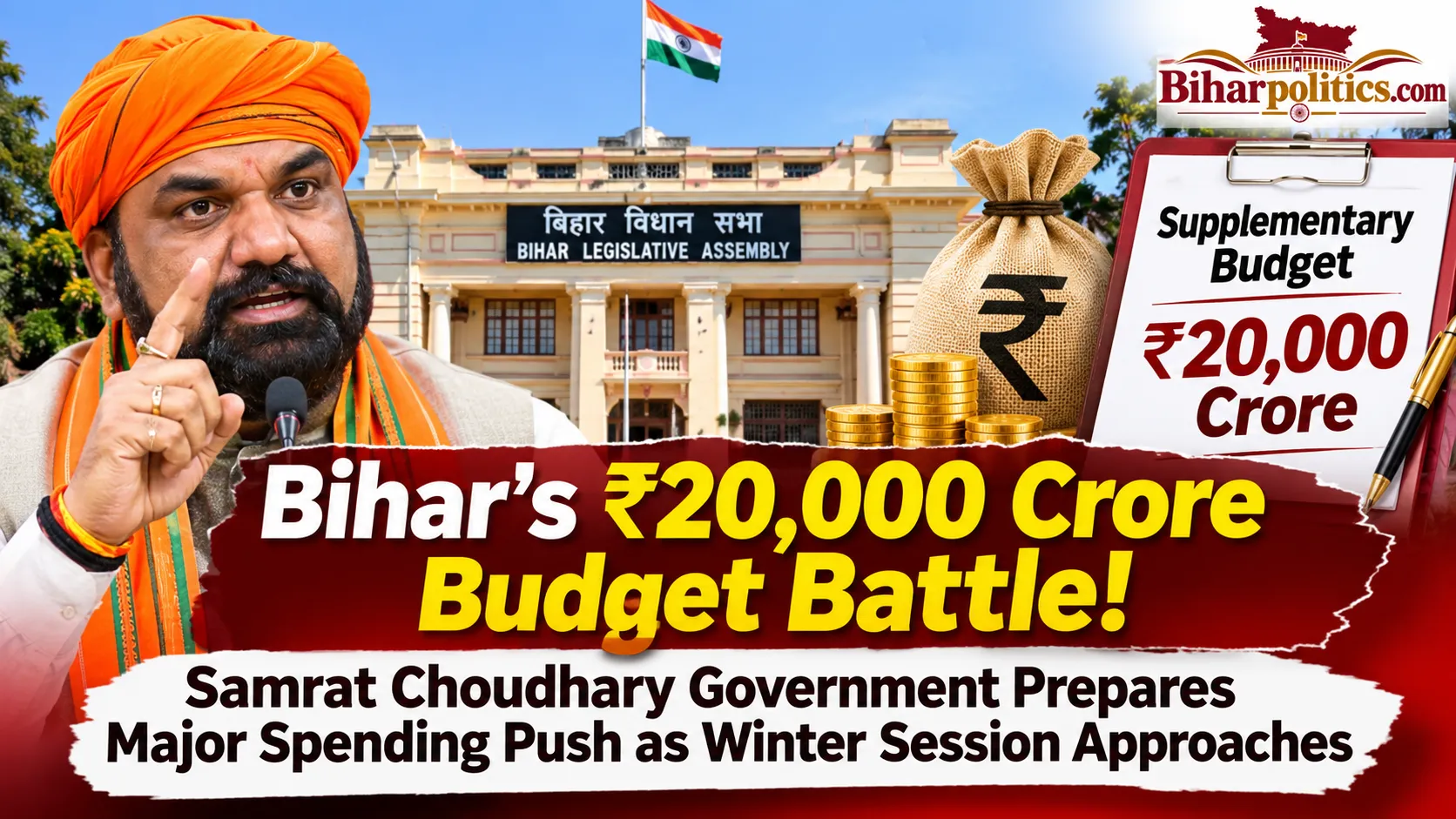
Bihar's ₹20,000 Crore Budget Battle! Samrat Choudhary Government Prepares Major Spending Push as Winter Session Approaches
Introduction
A major financial discussion is approaching in Bihar as the Samrat Choudhary-led government prepares to introduce its second supplementary budget during the upcoming winter session of the Bihar Legislature.
The proposed allocation is estimated at around ₹20,000 crore. Education, healthcare, rural development and infrastructure are among the sectors expected to receive additional financial support.
The development comes at a crucial time when the state government faces expectations to accelerate development projects and improve public services.
Winter Session Becomes the Centre of Attention
The Bihar Legislature's winter session is scheduled to begin on November 30 and continue until December 4, 2026.
The government is expected to present the second supplementary budget on the opening day.
According to the provisional legislative schedule, December 3 has been set aside for discussion and voting on the supplementary expenditure statement and the related appropriation legislation.
This session will provide opposition parties an opportunity to question the government's spending priorities.
Education and Healthcare in Focus
Education and healthcare are among the major sectors expected to benefit from the proposed additional funding.
Additional resources could support educational infrastructure, public healthcare facilities and the implementation of ongoing development programmes.
Rural development is another important area. Bihar's villages continue to require improvements in roads, public infrastructure and essential services.
However, the exact department-wise allocation will become clear only after the government presents the detailed budget documents.
Political Implications for Samrat Choudhary
For Chief Minister Samrat Choudhary, the supplementary budget is more than a financial exercise.
It will provide an opportunity for his government to demonstrate its priorities and communicate its development agenda.
The opposition, particularly the RJD and Congress, may scrutinise the proposed expenditure and demand transparency regarding implementation.
The real political question will be whether the additional spending translates into visible improvements in people's lives.
What Happens Next?
The next important date is November 30, when the winter session begins and the supplementary budget is expected to be presented.
December 3 will be particularly important for legislative discussion and voting.
The government will need to explain its financial priorities while responding to questions from legislators.
Conclusion
Bihar's proposed ₹20,000 crore supplementary budget has placed public spending and development at the centre of the state's political conversation.
For Samrat Choudhary, the challenge will not simply be securing legislative approval. It will be ensuring that the proposed financial support delivers measurable results.