
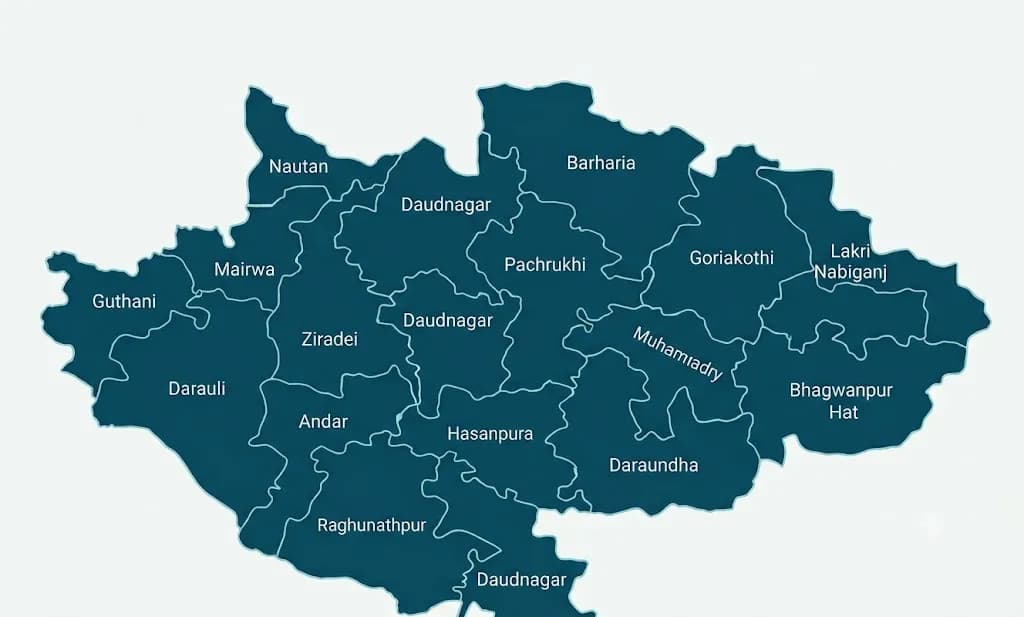
Siwan
Siwan District, Bihar — A historically rich and culturally vibrant district in western Bihar, headquartered in Siwan. Known as the birthplace of India's first President, Dr. Rajendra Prasad, and renowned for its high literacy rate and active socio-political landscape.
- Headquarters
- Siwan
- Division
- Saran Division
- Established
- 1976
- Area
- 2,219 sq km
- Population
- 3,330,463 (Census 2011)
- Lok Sabha
- Siwan, Maharajganj
- Vidhan Sabha
- Siwan | Ziradei | Darauli | Raghunathpur | Daraunda | Barharia | Goriyakothi
Siwan District, Bihar
Overview
Siwan is a prominent and densely populated district located in the western part of Bihar, forming a key part of the Saran Division. Bordered by the state of Uttar Pradesh and districts like Gopalganj and Saran, Siwan is celebrated for its deep historical roots, educational consciousness, and significant contribution to national leadership.
History and Heritage
Siwan holds an esteemed place in modern Indian history as the birthplace of Bharat Ratna Dr. Rajendra Prasad, the first President of Independent India, who was born in Ziradei village. In ancient times, the region was part of the powerful Kosala kingdom and later under the Mauryan and Gupta empires. The district was carved out of the former Saran district and established as an independent district in 1976.
Geography and Administration
Siwan district covers an area of approximately 2,219 square kilometres. The terrain is flat, fertile alluvial plain formed by the Gandak and Ghaghra river systems, making it highly suitable for intense agriculture. Administratively, the district is organized into several subdivisions and community development blocks to manage local governance effectively.
Population and Demographics
According to the Census of India 2011, Siwan district recorded a population of 3,330,463. The region boasts a notably high literacy rate compared to the state average. Hindi and Bhojpuri are the primary languages spoken by the residents, reflecting the distinct cultural ethos of the Bhojpuri-speaking belt.
Economy and Agriculture
The local economy is predominantly agrarian, supported by fertile soil and good irrigation networks linked to regional rivers. Paddy, wheat, sugarcane, and maize are the major crops cultivated. Additionally, remittance from migrant workers and small-scale trade contribute significantly to the local economy.
Political Significance
Siwan occupies a dynamic and influential position in Bihar's political landscape. The district encompasses the Siwan and Maharajganj Lok Sabha constituencies, along with several Bihar Legislative Assembly seats including Siwan, Ziradei, Darauli, Raghunathpur, Daraunda, Barharia, and Goriyakothi, which witness high electoral engagement.
Culture, Tourism, and Education
Cultural life in Siwan is vibrant, featuring traditional folk music, festivals, and historical landmarks like the birth site of Dr. Rajendra Prasad in Ziradei and several ancient temples. The district serves as a notable regional hub for higher education and schooling, with numerous colleges and institutions attracting students from nearby areas.