
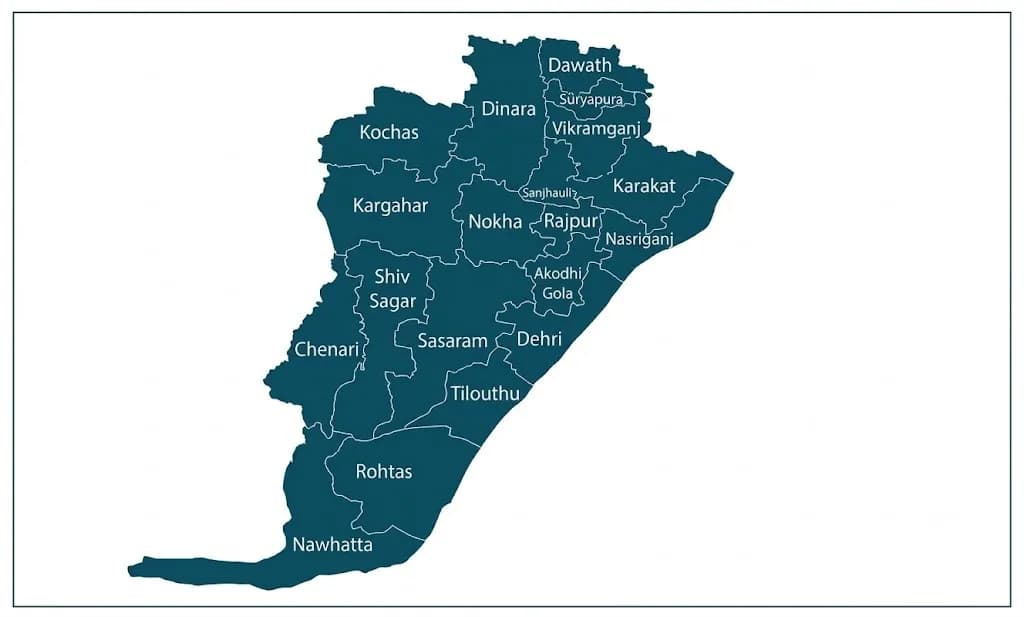
Rohtas
Rohtas District, Bihar— A historically rich and agriculturally prosperous district in southwestern Bihar, headquartered in Sasaram. Known for the legendary Rohtasgarh Fort, Sher Shah Suri Tomb, and as Bihar's major "Rice Bowl" with high agricultural output and key political and administrative significance.
- Headquarters
- Sasaram
- Division
- Patna Division
- Established
- 1972
- Area
- 3,850 sq. km
- Population
- 2,959,949 (Census 2011)
- Lok Sabha
- Sasaram, Karakat
- Vidhan Sabha
- Sasaram | Dehri | Karakat | Dinara | Nokha | Chenari
Rohtas District, Bihar
Overview
Rohtas is a historically significant and agriculturally prosperous district in southwestern Bihar, headquartered in the ancient town of Sasaram. Flanked by the River Sone on the east and bordering the state of Uttar Pradesh, the district is renowned for its rich heritage, monumental architecture, and major role in the region's agricultural production.
History and Heritage
Rohtas holds a prominent place in Indian history, named after the legendary Rohitashwa, son of King Harishchandra. The region boasts the magnificent Rohtasgarh Fort, one of the largest and most impregnable hill forts in India, showcasing centuries of architectural brilliance. Sasaram, the district headquarters, is globally famous for the majestic Sher Shah Suri Tomb, a masterpiece of Indo-Islamic architecture built right in the middle of an artificial lake.
Geography and Administration
Rohtas district covers approximately 3,850 square kilometres and forms a key part of the Patna Division. The terrain transitions from fertile alluvial plains along the Sone River to the rugged Kaimur plateau in the southern parts, rich in forest cover and mineral resources. Administratively, the district is divided into multiple subdivisions and blocks to streamline governance and rural development.
Population and Demographics
According to the Census of India 2011, Rohtas district recorded a population of 2,959,949. The district features a balanced mix of urban centers and vibrant rural communities. Hindi and Bhojpuri are the primary languages spoken across the region.
Economy and Agriculture
Rohtas is often referred to as the "Rice Bowl of Bihar" due to its highly fertile soil and advanced agricultural practices. Paddy (rice) and wheat are cultivated extensively, supported by the Sone Canal irrigation system. Besides agriculture, stone quarrying, cement manufacturing, and local commerce contribute significantly to the local economy.
Political Significance
Rohtas plays an active role in Bihar's political and electoral landscape. The district encompasses portions of the Lok Sabha constituencies of Sasaram and Karakat, and features key legislative assembly segments including Sasaram, Dehri, Karakat, Dinara, Nokha, and Chenari, representing a dynamic mix of rural and semi-urban aspirations.
Culture, Tourism, and Education
The district attracts history enthusiasts, pilgrims, and tourists due to landmarks like the Sher Shah Suri Tomb, Rohtasgarh Fort, and various ancient temples. Rohtas also boasts a high literacy rate compared to the state average, with Sasaram serving as a growing educational hub with schools, colleges, and coaching centers.