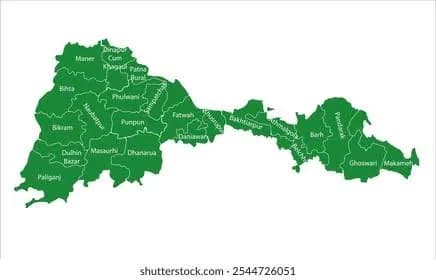
Patna is the capital district of Bihar and a major centre of governance, education, commerce and historical heritage. Located along the southern bank of the Ganga, the district is known for its ancient history, administrative importance and vibrant political landscape.
Patna is one of the most important districts in Bihar and serves as the state's political, administrative and economic centre. Located along the southern bank of the River Ganga, the district combines a historic urban centre with rural communities and agricultural areas. Patna city is both the district headquarters and the capital of Bihar.
History and Heritage
Patna has a history spanning more than two thousand years. Known in ancient times as Pataliputra, the city was an important centre of administration, trade, education and culture under powerful Indian empires, including the Maurya and Gupta dynasties. Over time, the city became known by several names, including Azimabad, before the name Patna became established.
The district was constituted in 1865 from portions of the former districts of Behar and Tirhut. Patna later became the capital of the province of Bihar and Orissa in 1912, strengthening its role as a major administrative centre in eastern India.
Geography and Administration
Patna district covers approximately 3,202 square kilometres and forms part of Patna Division. The River Ganga is a major geographical feature of the region, while the Sone and Punpun rivers also influence its landscape and agricultural activities.
The district includes urban centres, towns and rural settlements. Its administrative structure supports local governance, public services, infrastructure development and rural development programmes.
Population and Demographics
According to the Census of India 2011, Patna district had a population of 5,838,465. The district includes densely populated urban neighbourhoods as well as villages and agricultural communities. Hindi and Magahi are widely spoken, alongside Urdu and other regional languages.
Patna's population, educational institutions, healthcare facilities and administrative infrastructure make it one of Bihar's principal centres for public services and economic activity.
Economy and Agriculture
Patna has a diverse economy supported by government administration, education, healthcare, retail, transportation, construction and other service industries. The city attracts students, professionals, businesses and visitors from across Bihar.
Agriculture remains important in rural parts of the district. Rice, wheat, maize, pulses, oilseeds and vegetables are among the crops cultivated in the region. Fertile alluvial soils and access to urban markets support agricultural production and trade.
Political Significance
Patna plays a central role in Bihar's political landscape because it houses the state government, legislature and major administrative institutions. The district includes two Lok Sabha constituencies: Patna Sahib and Pataliputra.
The district has 14 Bihar Legislative Assembly constituencies: Mokama, Barh, Bakhtiarpur, Digha, Bankipur, Kumhrar, Patna Sahib, Fatuha, Danapur, Maner, Phulwari (Scheduled Caste), Masaurhi (Scheduled Caste), Paliganj and Bikram.
These constituencies represent a diverse mix of urban and rural voters and contribute to political representation at both state and national levels.
Culture and Tourism
Patna has a rich cultural and historical identity shaped by ancient Indian civilisation, religious traditions and modern urban life. Important attractions include Golghar, Gandhi Maidan, Takht Sri Patna Sahib, Mahavir Mandir, Buddha Smriti Park and the Bihar Museum.
Takht Sri Patna Sahib is one of the most important Sikh pilgrimage sites and is associated with the birthplace of Guru Gobind Singh. The district's historical landmarks and religious sites attract visitors from different parts of India.
Education and Healthcare
Patna is a major educational centre in Bihar, with universities, colleges, professional institutions and competitive examination preparation centres. Students from across the state travel to Patna for higher education and career opportunities.
The district also has major hospitals, specialised healthcare facilities and public medical institutions that serve residents of Patna and neighbouring districts.
Transport and Connectivity
Patna is one of Bihar's principal transport hubs. Patna Junction connects the city with major railway routes, while Jay Prakash Narayan International Airport provides air connectivity to selected domestic destinations. Road networks connect the district to other important cities and districts across Bihar.
The city's transport infrastructure supports trade, tourism, education, government administration and daily commuting.
Development and Urban Growth
Patna continues to experience urban expansion, infrastructure development and growing demand for public services. Roads, bridges, public transport, housing, sanitation, education and healthcare remain important areas of development.
Balancing urban growth with environmental protection, traffic management and improved public services is an ongoing priority for the district.
Patna District Today
Patna remains one of Bihar's most influential districts because of its political importance, historical heritage, economic activity and educational infrastructure. From the legacy of ancient Pataliputra to its present role as the state capital, Patna continues to shape Bihar's cultural, administrative and political identity.
BREAKING
Video Campaign Creation • Voter Turnout Management • Political Campaign Management • Political Social Media & Digital Marketing • Live Streaming • Audio Campaign Creation • Facebook Marketing • Website • GST • IT • Software • Tax Consultant • Advertisement • Digital Marketing
Contact Us
We're here to listen
Reach our editorial and support team for questions, feedback, corrections, story ideas and collaboration opportunities.