
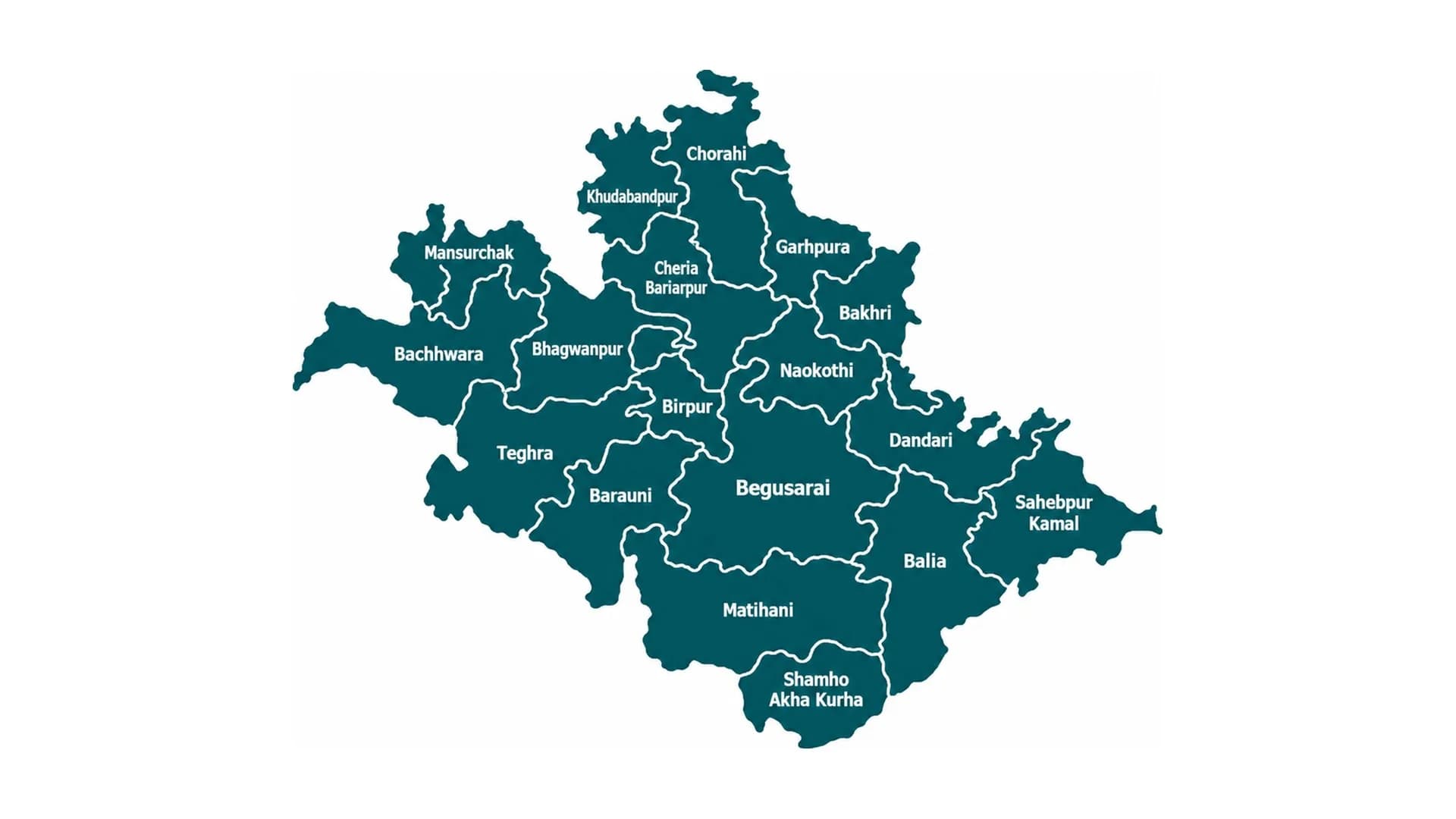
Begusarai
Begusarai is an important industrial and agricultural district of northern Bihar, located along the northern bank of the Ganga. It is known for Barauni's industrial infrastructure, Kabar Lake and its literary heritage.
- Headquarters
- Begusarai
- Division
- Munger Division
- Established
- 1972
- Area
- 1,918 sq km
- Population
- 2,970,541 (2011)
- Lok Sabha
- Begusarai
- Vidhan Sabha
- Cheria Bariarpur | Bachhwara | Teghra | Matihani | Sahebpur Kamal | Begusarai | Bakhri (SC)
Begusarai District, Bihar
Overview
Begusarai is a district located in northern Bihar and forms part of Munger Division. Begusarai town serves as its administrative headquarters. Situated near the northern bank of the River Ganga, the district has an important position in Bihar's agricultural, industrial and commercial landscape.
Begusarai is particularly known for the industrial centre of Barauni, its agricultural production, historical associations and Kabar Lake, an important wetland ecosystem.
History and Heritage
Begusarai has a historical identity connected with the Mithila region and the broader history of northern Bihar.
The district was established as a subdivision of Munger district in 1870 and became an independent district in 1972.
The name Begusarai is commonly explained through the words Begum and Sarai, reflecting a local historical association with the region's earlier settlements and pilgrimage traditions.
Begusarai is also associated with prominent literary and academic personalities, including Hindi poet Ramdhari Singh Dinkar and historian Ram Sharan Sharma.
Geography and Administration
Begusarai covers approximately 1,918 square kilometres and belongs to Munger Division. It is located on the northern bank of the River Ganga.
The district is surrounded by Samastipur in the north, the Ganga and Lakhisarai towards the south, Khagaria and Munger towards the east, and Samastipur and parts of Patna district towards the west.
The administrative headquarters is Begusarai town. The district has five subdivisions: Begusarai Sadar, Manjhaul, Teghra, Balia and Bakhari, along with eighteen administrative blocks.
Population and Demographics
According to the Census of India 2011, Begusarai district had a population of 2,970,541.
The district recorded a literacy rate of approximately 59.13%. Hindi and other regional languages are used across its urban and rural communities.
The population is distributed across industrial towns, agricultural settlements and developing urban centres.
Economy and Agriculture
Begusarai has a diverse economy supported by agriculture, manufacturing, industrial activity and trade.
Paddy, wheat, maize and sugarcane are among the important agricultural crops cultivated in the district. The fertile plains and access to water resources support farming and agricultural trade.
Barauni is a major industrial centre in Bihar. Its industrial infrastructure includes petroleum refining, fertiliser production and associated industrial and transportation activities.
Local markets, small businesses, food processing and service industries also contribute to the district's economy.
Political Significance
Begusarai has an important position in Bihar's political landscape. The district is represented in Parliament through the Begusarai Lok Sabha constituency.
It has seven Bihar Legislative Assembly constituencies: Cheria Bariyarpur, Bachhwara, Teghra, Matihani, Sahebpur Kamal, Begusarai and Bakhri (Scheduled Caste).
These constituencies represent the district's industrial towns, rural communities and agricultural areas in state and national legislative institutions.
Culture and Tourism
Begusarai has a rich cultural and literary heritage. It is associated with Ramdhari Singh Dinkar, one of the prominent Hindi poets of modern India, and historian Ram Sharan Sharma.
Kabar Lake, also known as Kanwar Lake, is an important wetland and bird habitat in the district. It attracts migratory birds and has ecological significance.
Jai Mangla Temple and Naulakha Temple are among the district's recognised religious and cultural attractions.
Traditional festivals, local fairs and community celebrations contribute to the cultural identity of Begusarai.
Education and Healthcare
Begusarai has schools, colleges, technical institutions and other educational facilities serving students from urban and rural areas.
Government hospitals, health centres and private medical facilities provide healthcare services to residents. Barauni and Begusarai town are important centres for access to public and private services.
Transport and Connectivity
Begusarai is connected to other parts of Bihar through road and railway networks. The district's location along the Ganga and its proximity to important industrial centres make transportation significant for trade and passenger movement.
National highway connections and railway routes link Begusarai with Patna, Munger, Samastipur and other major destinations.
Barauni is an important railway and industrial transportation centre.
Development and Urban Growth
Industrial development, agricultural modernisation, wetland conservation, road connectivity and employment generation are important priorities for Begusarai.
The district's industrial base provides opportunities for economic development, while environmental management remains significant around industrial facilities and Kabar Lake.
Begusarai District Today
Begusarai remains one of Bihar's important industrial and agricultural districts. Its industrial infrastructure at Barauni, agricultural economy, literary heritage and ecological importance make it a significant part of northern Bihar. The district continues to contribute to regional employment, trade and economic development.