
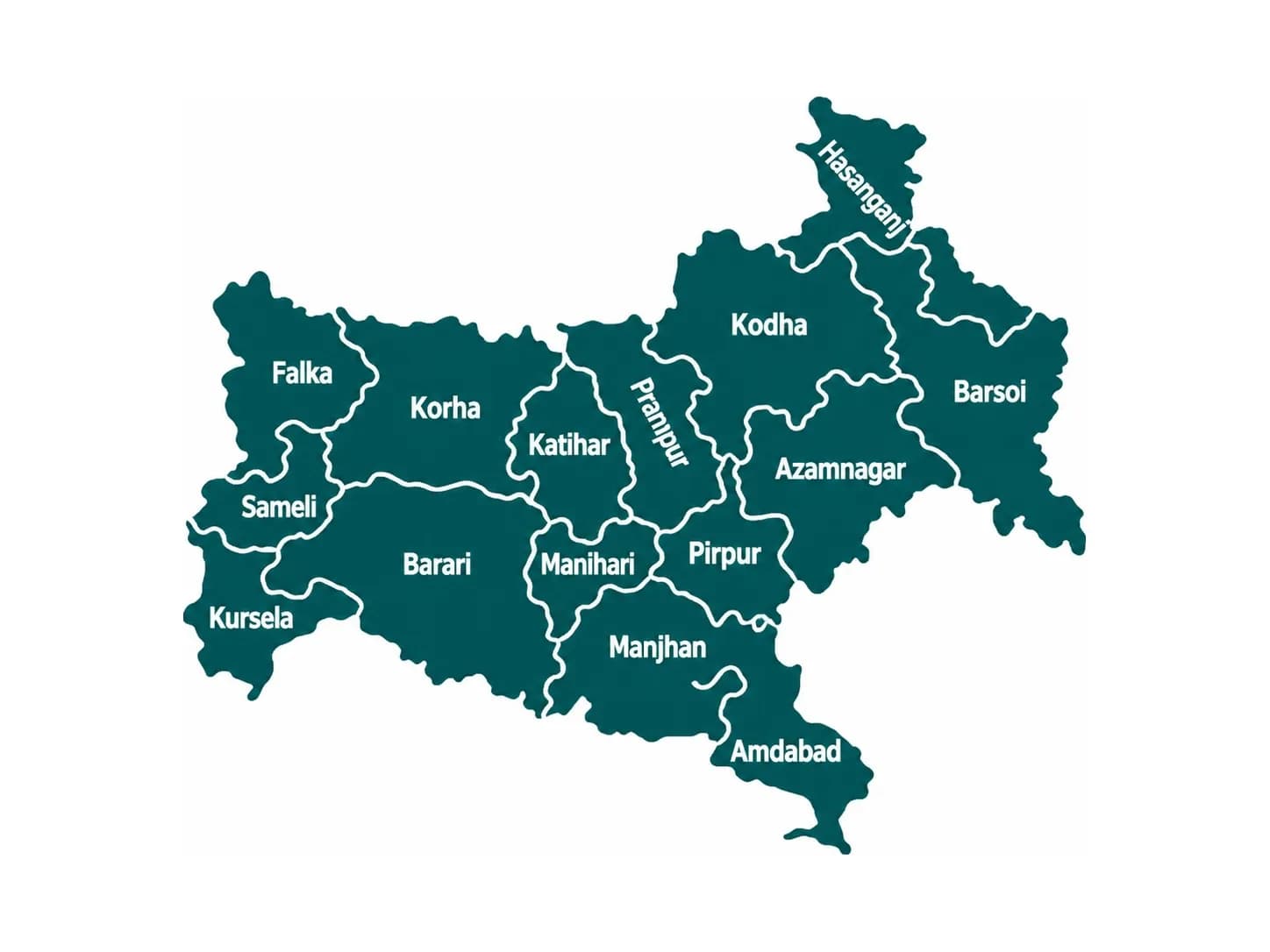
Katihar
Katihar is an important district in northeastern Bihar, recognised for its agricultural economy, railway connectivity and cultural diversity. Established as a separate district in 1973 after being separated from Purnia, Katihar serves as the administrative headquarters of Purnia Division. The district's fertile agricultural land, major rivers and commercial activities make it an important economic centre of the Seemanchal region.
- Headquarters
- Katihar
- Division
- Purnia Division
- Established
- 1973
- Area
- 3,056 sq. km
- Population
- 3,071,029 (Census 2011)
- Lok Sabha
- Katihar
- Vidhan Sabha
- Katihar | Kadwa | Balrampur | Pranpur | Manihari (ST) | Barari | Korha (SC)
Katihar District, Bihar
Overview
Katihar is a prominent district in northeastern Bihar, known for its agricultural production, railway connectivity and commercial importance. Katihar town serves as the district headquarters, and the district forms part of Purnia Division.
Its location near the Ganga and other major rivers gives it an important geographical and economic position in the Seemanchal region.
History and Heritage
Katihar has historical associations with the ancient Anga and Magadha regions. The area experienced different phases of political and administrative development under successive rulers, including the Mughals and the British.
Katihar was previously part of Purnia district. It became an independent district on 2 October 1973, following administrative reorganisation.
Geography and Administration
Katihar covers approximately 3,056 square kilometres in northeastern Bihar.
The district forms part of Purnia Division and has three subdivisions: Katihar, Barsoi and Manihari.
It has 16 development blocks: Katihar, Dandkhora, Hasanganj, Korha, Sameli, Falka, Kursela, Barari, Mansahi, Pranpur, Barsoi, Balrampur, Azamnagar, Kadwa, Manihari and Amdabad.
The Ganga, Kosi, Mahananda and Righa rivers are important geographical features of the district.
Population and Demographics
According to the Census of India 2011, Katihar district had a population of 3,071,029.
The district has a diverse population consisting of urban communities, agricultural households, traders and rural settlements. Hindi and regional languages are widely used in everyday communication.
Economy and Agriculture
Agriculture is a major contributor to Katihar's economy.
Rice, wheat, maize and banana are among the important agricultural products. The district also produces vegetables such as potatoes, onions and cauliflower.
Local markets support agricultural trade, food distribution and small businesses. Katihar's railway connectivity also supports commercial transportation and regional trade.
Political Significance
Katihar plays an important role in the electoral politics of northeastern Bihar.
Katihar is the district's Lok Sabha constituency.
The district has seven Bihar Legislative Assembly constituencies: Katihar, Kadwa, Balrampur, Pranpur, Manihari (ST), Barari and Korha (SC).
These constituencies represent different communities and geographical areas of the district.
Culture and Tourism
Katihar has a diverse cultural and religious identity shaped by its regional traditions and historical connections.
Gogabil Lake, situated in Amdabad block, is an important natural attraction and wetland area.
The historical Gurudwara associated with Guru Tegh Bahadur Sahib at Lakshmipur in Barari block is another important religious site.
Manihari is also known for its religious significance and its location near the Ganga River.
Education and Healthcare
Katihar has educational institutions, government schools, colleges and professional training facilities serving the population of northeastern Bihar.
Government hospitals, community health centres and primary health facilities support healthcare services across the district.
Transport and Connectivity
Katihar is one of the important railway centres of northeastern Bihar. Katihar Junction connects the district with major destinations across India.
Road networks connect Katihar with Purnia, Bhagalpur, Kishanganj and other neighbouring districts.
Its railway infrastructure supports passenger movement, agricultural transportation and commercial activities.
Development and Urban Growth
Agricultural infrastructure, railway development, road connectivity, flood management, healthcare, education and employment generation remain important priorities.
Improving irrigation, agricultural storage and marketing facilities can strengthen the district's rural economy.
Katihar District Today
Katihar continues to be an important district in northeastern Bihar because of its agricultural production, transport infrastructure and commercial importance. Its position within the Seemanchal region makes it significant for regional development and political representation.